Showing posts with label Africa. Show all posts

Friday, February 20, 2026

21st February World Pangolin Day

World Pangolin Day happens on the third Saturday of every February, falling on 21st February this year. Pangolins play a critical role in their ecosystems, providing the Earth with all-natural pest control and are fantastic soil tenders simply through their everyday behaviours.

This is a day to raise awareness for pangolins, the world’s only scaled mammal and the most illegally traded mammal in the world. The pangolin is also known as a scaly anteater and resides in Africa and Asia. All eight species of pangolins are in danger, and the two most-endangered pangolin species may become extinct within ten years. mammal. Their scales serve as armour to fend off predators, but unfortunately, these scales can do nothing to protect them from the biggest threat to their existence: humans. 

I have written about pangolins before and how I first learned of their existence so use the search bar to read these blogs. It is much easier to introduce them to students now as there are so many more good nonfiction books about them, such as this one, part of a series which is popular in our library.


Others to look for:


And a new story:


Thursday, August 21, 2025

August is for Antelope Month

What is an antelope? And why do they need a whole month to celebrate? 

Antelopes are hoofed mammals with hollow horns commonly mistaken for deer. The name ‘antelope’ is a catch-all term for many species in the Bovidae family. 

Antelopes come in a staggering range of shapes and sizes, with some built for pure speed and others for agility. The largest antelope (the  giant eland) can stand as tall as 182 centimetres, while the smallest (the royal antelope) is only 25 centimetres tall.

Antelope is a catchall term for an astonishing variety of ruminating ungulates. Have you heard of or seen the word eland, gazelle, kudu, oryx, rhebok, springbok, impala, dik-dik, duiker? They are all antelopes. Impalas are widespread and abundant throughout much of sub-Saharan Africa and are easily one of the most common antelope species. 

The rarest antelope in Africa is the Hirola. It is critically endangered as there is estimated to be only 300-500 left in the wild. Because of its scarcity the hirola has a day to itself. It is Hirola Day on 12th August. 


All living antelope species are found in Africa and Asia (including parts of the Middle East). Most species are found in Africa.

Did you know that Uganda is home to about 29 antelope species, which is nearly a third of the species found across Africa? 


There might be a lot of different types of antelopes, but there aren't many children's books about them. Probably because there isn't the need. A child who  lives in Africa can probably identify many of them and use the correct name. A child in Australia hasn't the need to know all those names. When we look at animals of the African savannah, the students love saying wildebeest, gnu and impala.  The best book to have if you want to get to know antelope is:


You may also be able to find some of these:


Often my students will look at an antelope and call it a deer, but antelopes and deer are different. Antelopes belong to the Bovidae family, made up of sheep, goats and cattle; whereas deer are members of the Cervidae family, which includes muntjac, elk, red and fallow deer, reindeer, roe deer, and moose. 

Both deer and antelope are hoofed animals (known as ‘ungulates’). They are also ruminant mammals, which means they have multiple stomachs. This allows them to swallow food and then bring it back up for a second munch – a process known as ‘chewing cud’. 

Antelope are indigenous to most of Africa, India, the Middle East, Central Asia, and parts of Eastern Europe, while deer originally come from the Northern Hemisphere, but are now native to Europe, Asia, North America and South America.

Deer have antlers that are shed and regrown annually, whereas antelopes have permanent horns that are not shed.
There are not many books about deer either, but they are much more likely to be found as characters in storybooks. Think of stories that feature reindeer and  moose for starters.

Tuesday, January 28, 2025

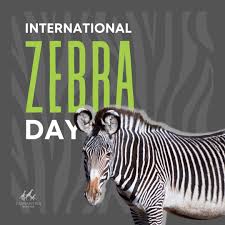
31st January International Zebra Day


Zebras are herbivorous mammals native to Africa! There are three species, the Grevy's zebra, the mountain zebra, and the plains zebra. Related to horses and donkeys, they spend 60% of their time eating, and each one of them has distinctive patterns and stripes. This day is in place to raise awareness about conservation needs. The Grevy's zebra is considered endangered on the Red List of Threatened Species, as its population has decreased by 54% over the past three decades. Zebras face risks of poaching, hunted for their meat and skin.


We haven't celebrated Zebra day at school before because it is usually before school starts, but school starts for our students before  the 31st this year so we have put together a small display of zebra books.


The most borrowed zebra book in our library is Ziggy the Zebra by Jan Latta and no doubt it will be again this year as her books are popular with the students who do the Premier's Reading Challenge.

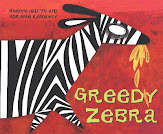
My favourite zebra story to read aloud is Greedy Zebra  by Mwenye Hadithi. The students love discovering why the zebra looks as it does.

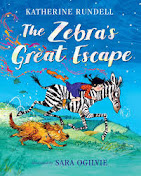
The Zebra's Great Escape  by Katherine Rundell is a longer picture book, but it is such a wonderful adventure.

There are two endearing stories for very young children about a zebra called Zou by Michael Gay.

A Zeal of Zebras  is a quirky book with great illustrations about collective nouns.


Still want more?


Thursday, June 15, 2023

16th June Day of the African Child

Day of the African Child (DAC) was instituted in 1991 by the Assembly of Heads of State and Government of the OAU in memory of the 16th June 1976 student uprising in Soweto, South Africa. At that time, students marched protesting the poor-quality education they received and demanding to be taught in their languages. During the protest hundreds of school children were killed. The Day of the African Child is celebrated to commemorate these children and the brave action they took to defend their rights. The Day of the African Child also serves to celebrate children of Africa as well as inspire a sober reflection and action towards addressing the challenges that children in Africa face on a daily basis.

We are lucky in Australia to be able to get children books from all over the world. Unfortunately some of them are getting very expensive as the Australian dollar drops in value, but nevertheless we can get them and our students can read about African children. There are several books in our library that enable readers to meet African children. We can read books by African authors such as Niki Daly, Jude Daly, Ken Wilson Max which are easily available, but there are other black African authors, such as Nansubuga Nagadya Isdahl,  who are at the beginning of their career and who will become more well known. Below are books that will introduce you to African children. They are not all written by African authors but they do allow our children to see others' lives.

• In Once Upon a Time by Niki Daly we meet Sarie, a rural South African girl, who dreads reading aloud in school: words on the page "tripped up her tongue. She stuttered and stammered over them." Just the reason African schools should have children's books in their first language! And if you have children who think their school life is hard read Rain School by James Rumford.

• Meet Handa if you haven't already, in the wonderful set of titles by Eileen Browne, Handa's Surprise, Handa's Hen , Handa's Noisy Night and Handa's Surprising Day.

• Meet Anna Hibiscus, a child living in modern West Africa. She lives in Nigeria with her mother, her father, her baby twin brothers, and lots and lots of her family.  She is the main character in a series of books by Atinuke. There are three picture books,  Anna Hibiscus' Song, Splash Anna Hibiscus! and Double Trouble for Anna Hibiscus! and eight short chapter books.

• Atinuke also has a series of books, Too Small Tola about Tola who lives in a flat in Lagos with her sister, Moji, who is very clever, her brother Dapo who is very fast and her Grandmummy who is very bossy. Tola is small but determined. There are already four titles.

• A third series by Atinuke, The Number One Car Spotter is about Oluwalase Babatunde Benson or No 1 as he is known. His hobby is car spotting and he is good at solving all the problems in his village. There are six books!

Meet Jamela, a mischievous young girl who has lots of fun in books about her life with her mother. Niki Daly has written and illustrated five endearing Jamela titles, not all of which are still in print.

• In another newer book by Niki Daly, On My Papa's Shoulders we meet a child who has just started school and this story introduces his whole family, Mama, Papa, Gogo and Tata and their South African urban environment.

Meet Lolo, another of Daly's enchanting South African children. She lives with her mother and Gogo. There are now four early reader chapter books about her, Here Comes LoloHooray for Lolo, You're a Star, Lolo and Fly High Lolo.

• Meet Lalla in Deep in the Sahara by Kelly Cunnane. She  lives in the Muslim country of Mauritania, and more than anything, she wants to wear a malafa, the colourful cloth Mauritanian women, like her mama and big sister, wear to cover their heads and clothes in public.

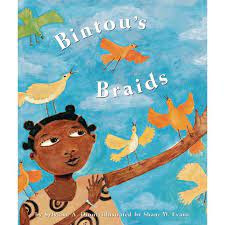
• Meet Bintou in Bintou's Braids by Sylvaine Diouf.  She wants braids. Long, pretty braids, woven with gold coins and seashells, just like her older sister and the other women in her family. But she is too young for braids.

• Meet Beatrice in Beatrice's Goat  by Page McBrier. More than anything, Beatrice longs to be a schoolgirl. But in her small African village, only children who can afford uniforms and books can go to school. Beatrice knows that with six children to care for, her family is much too poor. But when Beatrice receives a wonderful gift from some people far away -- a goat she names Mugisa (which means "luck") who gives milk that Beatrice can sell. With Mugisa's help, it looks as if Beatrice's dream may come true after all. 

• Meet Saruni in My Rows and Piles of Coins by Tololwa M. Moller. Saruni is saving his precious coins for a red and blue bicycle. How happy he will be when he can help his mother carry heavy loads to market on his very own bicycle--and how disappointed he is to discover that he hasn't saved nearly enough! 

• Meet Mustafa in My Father's Shop by Satomi Ichikawa There is a rug in his father's  shop in Morocco that Mustafa loves. Mustafa s father would like him to know some words in other languages too, and he tells Mustafa that he may have the rug if he agrees to learn. He finds a very different way of learning foreign languages...and of getting tourists to visit his father's shop. This book will really make you smile. Read this alongside Jeannie Baker's Mirror.

• Meet Fatima in Gogo's List by Portia Derry. Fatima is a young girl in Ghana who is determined to save the day. She wants to help Gogo with her to-do list so that everyone will realise that she is a big girl now! But things don’t go exactly as expected ... 

Meet Kondi in Galimoto by Karen Lynn Williams. Kondi is determined to make a galimoto -- a toy vehicle made of wire. His brother laughs at the idea, but all day Kondi goes about gathering up the wire he needs. By nightfall, his wonderful galimoto is ready for the village children to play with in the light of the moon.

Meet Gie Gie in The Water Princess by Susan Verde. Gie Gie is inspired by the childhood of African-born model Georgie Badiel. Clean drinking water is scarce in her small African village. And try as she might, Gie Gie cannot bring the water closer; she cannot make it run clearer. Every morning, she rises before the sun to make the long journey to the well.

• Meet Jojo in Jojo's Wire Car by Veronica Lamond. Jojo is a busy little boy who lives with his granny in East Africa.He is expected to help with the chores, do well in school and also help earn money. One day, a Wire Car Competition is announced and, along with all the other village children, Jojo enters to try to win the prize.

• Meet Fatou in Fatou, Fetch the Water by Neil Griffiths. Fatou appears to be a very forgetful child. The story is set in the smallest country in Africa, The Gambia and the picture book contains a section of facts about the cultures and traditions of this colourful nation, so you can learn as well as enjoy.

• Meet Penda in  in Don't Spill the Milk  by Stephen Davies. Penda carries a bowl of milk on her head across dunes and the River Niger, and even up a mountain, without spilling a drop despite many distractions. She gets a surprise when she arrives at the grasslands to give her father his lunch. 


Of course the library has others too: