Showing posts with label Dr Seuss. Show all posts

Tuesday, August 9, 2016

8th August International Cat Day

I haven't written about any form of Cat Day before because where do I start and finish when talking about children's books about cats, but today I had a thought. This week one of my Year 2 students was reading the picture book biography about Wanda Gag and that gave me reason to pull Millions of Cats  off the shelf to show her. What a good place to start a post about cat books!  This book was first published in 1928 and although illustrated in black and white, young students do still enjoy the repeating refrain and imagining that number of cats. Compare this with a very new 2016 cat' picture book, Brendan Wenzel's They All Saw a Cat which also has a repeating refrain, a clear, crisp cat, but looks very closely at perspective, point of view and subjectivity.

"The cat walked through the world, with its whiskers, ears and paws ...and the child saw A CAT, and the dog saw A CAT, and the fox saw A CAT. Yes, they all saw the cat.' In simple, rhythmic prose and ingeniously stylised pictures, Brendan Wenzel takes young readers on a walk alongside a cat."

And in between these two there has been a myriad of cat books and series of books with a cat as the main character.

Some favourites:
• The Cat in the Hat by Dr Seuss
• Mog the Forgetful Cat by Judith Kerr
• Diary of a Killer Cat by Anne Fine
• Splat the Cat by Rob Scotton
• Binky the Space Cat by Ashley Spires
• Pete the Cat by Eric Litwin and James Dean
• Squishy McFluff the Invisible Cat by Pip Jones
• Ballet Cat by Bob Shea

And don't forget poetry!
• The Owl and the Pussycat by Edward Lear
• Cats Sleep Anywhere  by Eleanor Farjeon
• Macavity; Mr Mistoffelees; Skimbleshanks by T.S Eliot and Arthur Robins

Tuesday, July 29, 2014

29th July Kathleen Krull (1952)

Kathleen Krull's name appears in my library quite a lot at this time of the year because it is when Year 2 and I are completing a wide-reading contract using picture book biographies and Kathleen Krull seems to specialise in writing biographies so I was pleased to learn that today was her birthday.
Two of her biographies are included in the contract.  We have others of her biographies but I especially like these two because they are very relevant to my students' lives.

They are:
• The Boy on Fairfield Street (the story of a young Ted Geisel aka Dr Seuss)
• The Boy Who Invented TV (the story of Philo Farnsworth)

Some quotes I would share with my students from Kathleen's own biography would be ...
"When I was fifteen, I was fired from my part-time job at the library. The reason? Reading too much--while I was supposed to be working." 

"As a child I thought books were the most important thing in the world, and that perception is actually more intense now. I’m grateful, for so many reasons, to be able to work in a vital and exhilarating field: preserving literacy. One of the benefits of the writing life is that I can't be fired. Especially for reading too much."


Friday, July 27, 2012

Champions Read 4 - Literature


A great champion of children's literature died this week. Vale Margaret Mahy. She is the New Zealand author that most of us know well because of her abundance of books, ranging from picture books such as the ever-popular Great White Man-eating Shark, through great beginning chapter books such as The Great Piratical Rumbustification and The Dentist's Promise to her award-winning novels The Haunting and The Changeover. And in there as well there are anthologies of poetry and short stories. She is a popular author study choice with my teachers and so we purchased Questions Kids Ask Margaret Mahy.

There are books of this type and other straight biographies about many children's authors. Look for them on Roald Dahl, A.A.Milne, Beatrix Potter, Jacqueline Wilson and Dr Seuss. Mem Fox has even penned her own, Memories which is ideal for use with very young readers who are doing an author study on her, but if you want to look at picture book biographies that do a bit more than outline the chronology of their lives here are some suggestions:
• for Dr Seuss
The Boy on Fairfield Street by Kathleen Krull, Steve Johnson and Lou Fancher.
• for Beatrix Potter
My Dear Noel by Jane Johnson
Beatrix Potter by Alexandra Wallner
• for Wanda Gag
Wanda Gag : The Girl Who Lived to Draw by Deborah Kogan Ray
• for Roald Dahl
• D is for Dahl by Wendy Cooling and Quentin Blake

Monday, January 24, 2011

24th January


According to many calendars, yesterday, 23rd January was Measure Your Feet Day. Why I do not know, but when I started to think about books that you could use on a day with this moniker, there were plenty that leant themselves to having fun with this topic. If you want to plan an activity-based lesson for very young children, Aliki's My Feet would be a good starting point. You could also have fun with Dr Seuss' The Foot Book. Two good stories to read which look at feet, their size and gumboots are Alfie's Feet by Shirley Hughes and Muddy Footprints by Mary Small. For children who like ballet, Belinda Ballerina is the star of a series of books by Amy Young. Belinda wants to be a ballerina but she has a problem, two very big feet! And, lastly just because it is a story everyone should read and it is about feet, Four Feet, Two Sandals by Karen Lynn Williams.

Monday, March 1, 2010

2nd March Dr Seuss (1904 - 1991) Leo Dillon (1933) P.J. Lynch (1962)


I had fun today with my library classes. We worked out how old Dr Seuss would be today? "Is he still alive?" I asked. "Of course," said one Year 1 boy emphatically. "Of course not," said another. "How do you know?" I asked each of them. "Dr Seuss will live forever," said the boy who was sure he was alive. Whether he is or is not alive physically, and he isn't, the first boy is right. He will live forever because his books are still as popular as ever nineteen years after his death and over fifty years since some of them were published. I wonder if Spaulding, the publisher at Houghton Mifflin got what he expected when he gave Theodor Seuss Geisel the list of 300 or so commonly used words to make into a book suitable for Year 1 readers. The Cat in the Hat came back using only 236 of the words and it was a huge success and the beginning of a large number of books that many children have learned to read with.

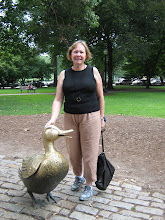
I went to Springfield last year on my way back from the Eric Carle Museum to Boston because I had to change buses there. I wish I knew then that the Seuss Memorial Sculpture Garden was there. What a shame I missed it because the bronze sculptures look as exciting as Boston's ducks, hare and tortoise and New York's Alice in Wonderland.