Showing posts with label Malala Yousafzai. Show all posts

Thursday, July 7, 2022

12th July Malala Day


On July 12, the United Nations recognises Malala Day in honour of education activist Malala Yousafzai. It’s also her birthday and the day she spoke to the UN in 2013.

In 2014, Malala was named the co-recipient of the 2014 Nobel Peace Prize for her work promoting equal education rights for all children.That made her the youngest Nobel Laureate.

Although Malala Day was established to honour Malala Yousafzai, she has said, it should also recognise advocacy for education rights all over the world. It is also a great opportunity for organisations, schools, and individuals to learn more about Malala’s work and the work of other young activists.  It is also a day for all children everywhere to raise their voices and be heard. It is a day to stand up for education and say to world that we are stronger than the enemies of education and stronger than the forces that threaten girls, boys and women from leading happy and productive lives. 

And it is not hard for students to learn more about Malala now, as there is so much written by her and about her. In our library there are all of these as well as anthologies where she has an entry:


I have written about Malala Day before and about educating girls.

Monday, January 3, 2022

SDG 4 Quality Education


Goal 4 Ensure inclusive and equitable education and promote lifelong learning opportunities for all.

There is so much we take for granted here in Australia when it comes to schooling and you read all the subgoals for this goal. We complain about dropping scores in global testing, in NAPLAN and lack of enough casual teachers, not the things listed here. Everyone in Australia has access to education that is safe, well-resourced and free so we should take advantage of it.


There are so many good books for this goal. Find some here.


If you just want to show very young children how different school can be from what they experience, read something like Rain School  by James Rumford or Elizabeti's School by Stephanie Stuve- Bodeen.

Here's the blurb:
It is the first day of school in Chad, Africa. Children are filling the road. "Will they give us a notebook?" Thomas asks. "Will they give us a pencil?" "Will I learn to read?" But when he and the other children arrive at the school yard, they find no classroom, no desks. Just a teacher. "We will build our school," she says. "This is our first lesson." James Rumford, who lived in Chad as a Peace Corps volunteer, fills these pages with the vibrant colours of Africa and the spare words of a poet to show how important learning is in a country where only a few children are able to go to school. 


Here's the blurb:
In this Tanzanian story it's the first day of school and Elizabeti can hardly wait. She puts on her new uniform and feels her shiny shoes. School must surely be a very special place!
Shortly after arriving at school, however, Elizabeti begins to miss her family. What if Mama needs help cleaning the rice? What if her baby sister wants to play? What if her little brother wants to go for a walk? But soon Elizabeti is making friends and learning her lessons. Best of all, she shares her experiences with her family that evening - and can apply what she has learned right away.


However, if you want students to know that school is not easily accessed for everyone, think about reading something more biographical, such as a book about Malala Yousafzai, Tererai Trent or Razia Jan.


There are three things to do:
Before reading ask:
How would you describe your school to someone who doesn't go to it? What is good about it?

Record the book you read
We read...

Finish this 
I wonder what education is like for ...


Sunday, August 12, 2018

12th July Malala Day

This week in my Year 2 Book Club, one of my students read the biography, For the Right to Learn: the Malala Yousafzai's Story.  She was horrified to think that there are places in the world where she might not be able to go to school. Another girl in the group read the biography of the first woman doctor, Elizabeth Blackwell, in Who Said Women Can't Be Doctors?  A discussion about education and gender resulted. The comments were very interesting, given that this group of students come from affluent, educated families, attend a private co-educational school and take education and the ability to get what they need for granted.  I took the opportunity to show the students the other biographies the library has about Malala and to encourage them to read other books about girls and education.

When Malala was growing up in Pakistan, girls were not allowed to go to school. Malala refused to stay home! She spoke out for education and was almost killed for standing up for her beliefs. To this day, Malala continues to work to ensure that every girl around the world has the chance to go to school. Malala Day is celebrated on her birthday, 12th July. The library has several books about her, including these:

• For the Right to Learn: the Malala Yousafzai's Story  by       Rebecca Langston-George and Janna Bock 
Malala's Magic Pencil by and


• Ruby's Wish by Shirin Yim Bridges
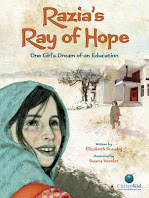
Razia's Ray of Hope by Elizabeth Suneby and Suana Verelst
The Girl Who Buried Her Dreams in a Can by Tererai Trent
Nasreen's Secret School: A True Story From Afghanistan by Jeanette Winter
Yasmin's Hammer by Ann Malaspina and Doug Chayka