Showing posts with label endangered species. Show all posts

Thursday, May 15, 2025

16th May Sun Bear Day and Endangered Species Day

Sun Bear Day is  observed on the third Friday in May every year. It highlights a threatened bear species, the sun bear, native to the tropical forests of Southeast Asia, occurring in India, Bangladesh, Myanmar, Thailand, Cambodia, Laos, and Vietnam, among others. It is the smallest of all types of bears, reaching 70 centimetres when standing. Their shy and elusive nature led them to be used as pets in the past. According to the IUCN Bear Specialist Group, the sun bear population has declined by 35% in the thirty years due to habitat fragmentation, deforestation, wildlife trade, and loss of food resources.Sydney's Taronga Zoo has a sun bear, Mary and and you can see and read about her here.


Tearing apart a 9kg watermelon with her sharp claws, Mary the Malayan sun bear wastes no time getting nose deep in a bear-y sweet surprise.


There are three books in the library about sun bears.


It is also Endangered Species Day which is appropriate because sun bears are a threatened species. An endangered species is a plant or animal facing extinction if its population numbers do not increase. There are a large number of animals and plants that are endangered and may books cover these either specifically or in a general text such as these: 

And coming later this year


Saturday, September 3, 2022

10th September National Bilby Day

National Bilby Day was officially launched in 2005 and the celebrations are held on the second Sunday of September.

The bilby is the only Australian animal with an official gazetted day of celebration!

This is because the bilby is so incredibly important as a flagship species – if they survive, so do many other threatened species and so they are the perfect critter to front biodiversity month in September. 

I wrote about this day back in 2010, but of course the library has added more books about bilbies since then. It does seem such a shame that books about animals such as bilbies have such small print runs and an audience limited to Australia, because it means they are out of print very quickly and then hard to find.

Here are some from the library:

• Bilby Secrets by Edel Wignell and Mark Jackson

• Bilbies and Bandicoots by Debbie and Brendan Gallagher

• Finding Out About Bilbies by Greg Pyers

• Bilby Friends  by Pamela Rushby

• Baby Bilby, Where Do You Sleep? by Narelle Oliver

• A Home for Bilby  by Joanne Crawford and Grace Fielding

• Hunwick's Egg by Mem Fox and Pamela Lofts

• Baby Bilby's Question by Sally Morgan and Adele Jaunn

• Little Barry Bilby had a Fly Upon his Nose and  Little Barry Bilby's Big Bush Band by Colin Buchanan and Roland Harvey

• Little  Bilby's Aussie Bush Christmas  by Yvonne Mes and Jody Michelle Pratt

• Little Bilby's Aussie Easter Egg Hunt by Yvonne Mes and Jody Michelle Pratt

• Bam the Bilby and the Wild Cat  by Paul Ashford Harris

• Show and Tell by Bruce Dawe

• The Bush Book Club  by Margaret Wild and Ben Wood

• The Smallest Bilby and the Midnight Star; The Smallest Bilby and the Easter Games; The Smallest Bilby and the Easter Tale by Nette Hilton and Bruce Whatley.


Friday, December 30, 2016

31st December Pangolins

I'm on holidays and enjoying having time to read all sorts of things I don't usually have time for like the newspaper. Today in the Sydney Morning Herald (page18 in an article by Lindsay Murdoch), I read something alarming about pangolins, an animal I first met in a wonderful picture book by Bert Kitchen called Tenrec's Twigs. This story is set in Madagascar and has an amazing array of obscure animals, supposedly native to there. A friend visited Madagascar recently and I told her to be sure to see a tenrec and a pangolin. Well she saw a tenrec, but not the pangolin. And reading this today I wonder if that is why.
" Among the environmentalists' biggest concerns in South-east Asia is the pangolin, a scaly aardvark-like mammal that is the inspiration for Pokemon's Sandlash, a character adept at battling foes. The real-life ant-eating and nocturnal pangolins have the dubious distinction of being the most poached animal on Earth...More than 100,000 of the shy and near-sighted animals are captured every year across Africa and Asia."


The UN's Convention on International Trade and Endangered Species (CITES) has banned global trade in pangolins in the hope that they do not become extinct, a good reason too, to ensure that the students we teach know about them. I bought these two books for the library, so that when I share Tenrec's Twigs I can offer the children more to read. Not a lot, but a start without having to look through an index in a general animal  nonfiction book.


Friday, September 9, 2016

7th September Threatened Species Day

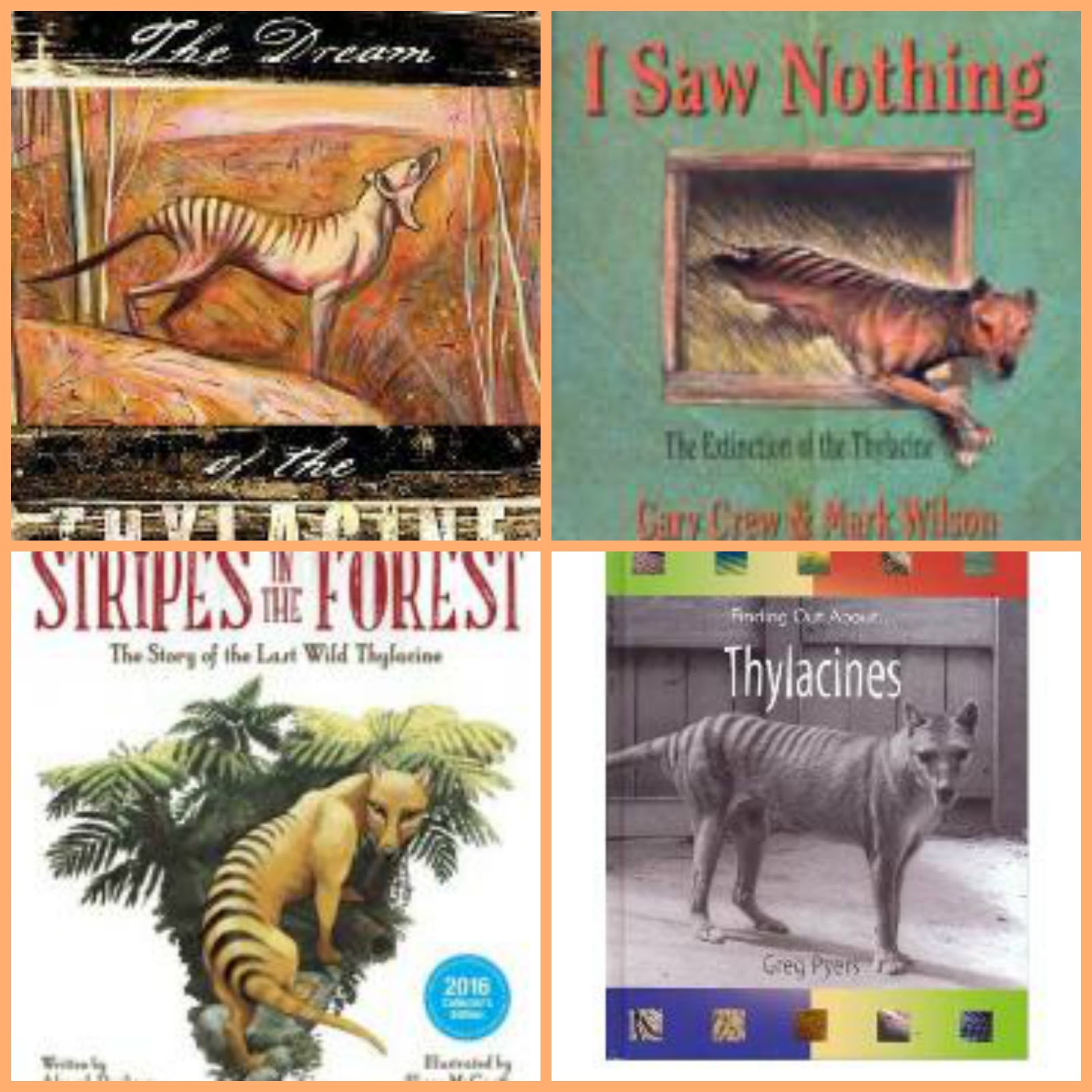
"Threatened Species Day is a national day held each year on 7 September to commemorate the death of the last remaining Tasmanian tiger (also known as the thylacine) at Hobart Zoo in 1936. It is a time to reflect on what has happened in the past and how we can protect our threatened species in the future. A day to celebrate our success stories and ongoing threatened species recovery work."
While there are some books about thylacines I had kindergarten on this day and wanted to read something slightly easier. I had recently purchased Penelope the Mountain Pygmy Possum, which is a story about a pygmy possum in the Snowy Mountains, and these possums are endangered. I knew that the idea of the tunnel under the road would appeal to Kindergarten. They ended up comparing this tunnel with a possum tunnel we have nearby on the Wakehurst Parkway that goes over the road. The information page at the back of the book brought us back to the real issue of pygmy possums and why they are endangered. Many of the children are skiers and spend time at Thredbo so they made some very pertinent connections with the text.  Then the  children wanted to borrow other books about pygmy possums which we don't have, but many borrowed books about Tasmanian devils and bilbies, both of which do also need saving. The conversation came back to the issue of the Lord Howe Island Stick Insect too and Zoos Victoria, so this term's reading has made for some good connections, both text-to-text and text-to-world. 


SaveSave