Mr S by Monica Arnaldo
It was the first day of school. But even the kindergarteners of room 2B could tell something was seriously wrong. . . . Where was the teacher? Who left this sandwich on the desk. The only clue, written on the chalkboard, was the three simple letters: Mr. S
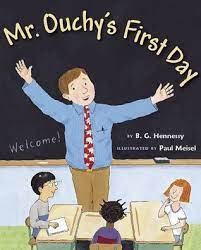
Mr Ouchy's First Day by B.G. Hennessy and Paul Meisel
Mr. Ouchy is nervous about his first day of school . . . even though he’s the teacher! Will his students like him? Will he be able to find the bathroom? What if he can’t remember his students’ names? Fortunately, his classroom keeps him busy; his students have plenty of their own questions, and the first day of school turns into a great day discussing things like Mr. Ouchy’s funny name, how long a minute really lasts, and what everyone wants to learn in the upcoming year—things like whistling, playing drums and drawing dinosaurs.
School's First Day of School by Adam Rex and Christian Robinson
It's the first day of school at Frederick Douglass Elementary and everyone's just a little bit nervous, especially the school itself. What will the children do once they come? Will they like the school? Will they be nice to him? The school has a rough start, but as the day goes on, he soon recovers when he sees that he's not the only one going through first-day jitters.
These three books are FUN! They help students laugh away first day jitters. They reassure students that they are not alone. They remind older students what starting school is like. Yet, they will not appear on a list of books for Kindergarten teachers introducing school to their new class. Next week when four new Kindergarten classes go into their new rooms with their new teachers in NSW they are more likely to be following a published English unit which has suggested texts.
The NSW Early Stage 1 English Unit for the start of school looks at Context by looking at the topic Starting School. These three books are not their reading suggestions. I do wonder why? At the school I teach at most of the kindergarteners have done at least two years of preschool on the same campus as their Kindergarten classroom, in a very similar uniform and with older brothers and sisters who are there so they have visited frequently. Even those who haven't, have been to some form of preschool or community long day care. Most have professional parents who value education and do all the right things to ready their child for school, including sharing 'starting school books' from the library.
My other problem is that at my school there are four Kindergarten classes and they all want the same library book as a mentor text on the same day! And if you have four copies they will only be used in those two weeks and then sit on the shelf...not a good use of resources and not good in my context because the library shelves are very full.
I have tried talking about how these texts are suggestions only and how you could still meet the outcomes using other texts. I have also talked about how the suggestions are 'products of their time' and that new books have been published since, that would work or that the library has older out of print texts that also could work. The units are only as good as the unit writers' knowledge of children's books and what is available to them.
So please embrace the concept of companion texts. What do I mean by a companion text? A book that has a similar theme, context, set of characters, and / or similar Tier 2 vocabulary. It may suit your cohort better because you are teaching a group of more diverse students and you want them to see themselves in the text. It may be less or more complex depending upon your students prior knowledge and school experiences. It may just be an extra book that you read during the week. Please look widely, search out alternatives, speak to your teacher librarian for suggestions, look online at what other teachers have used.
The unit suggests you use these two books:
• Starting School by Jane Godwin and Anna Walker
• Little Nic's Big Day by Nic Naitanui and Fatima Anaya
and while both of these books are excellent, these are some companion texts worth looking at:
• The Starting School List by Kitty Black and Cate James
• First Day by Andrew Daddo and Jonathan Bentley
• Mae's First Day at School by Kate Berube
• Jessica's Box by Peter Carnavas
• My First Day at School by Meredith Costain and Michelle Mackintosh
• Ozzie Goes to School by Jocelyn Crabb and Danny Snell
and there's other starting school titles here.
The unit then recommends
• Families by Jane Godwin and Yael Frankel
This is a very 'simple' look at families and it may not suit your needs.
If you would like a wider more diverse view of families try these:
• Who's in My Family? by Robie H. Harris
• Big Book of Families by Catherine and Laurence Anholt
• All About Families by Felicity Brooks and Mar Ferrero
• Isla's Family Tree by Katrina McKelvey and Prue Pittock
and then look here.