Thursday, June 15, 2023

16th June Day of the African Child

Day of the African Child (DAC) was instituted in 1991 by the Assembly of Heads of State and Government of the OAU in memory of the 16th June 1976 student uprising in Soweto, South Africa. At that time, students marched protesting the poor-quality education they received and demanding to be taught in their languages. During the protest hundreds of school children were killed. The Day of the African Child is celebrated to commemorate these children and the brave action they took to defend their rights. The Day of the African Child also serves to celebrate children of Africa as well as inspire a sober reflection and action towards addressing the challenges that children in Africa face on a daily basis.

We are lucky in Australia to be able to get children books from all over the world. Unfortunately some of them are getting very expensive as the Australian dollar drops in value, but nevertheless we can get them and our students can read about African children. There are several books in our library that enable readers to meet African children. We can read books by African authors such as Niki Daly, Jude Daly, Ken Wilson Max which are easily available, but there are other black African authors, such as Nansubuga Nagadya Isdahl,  who are at the beginning of their career and who will become more well known. Below are books that will introduce you to African children. They are not all written by African authors but they do allow our children to see others' lives.

• In Once Upon a Time by Niki Daly we meet Sarie, a rural South African girl, who dreads reading aloud in school: words on the page "tripped up her tongue. She stuttered and stammered over them." Just the reason African schools should have children's books in their first language! And if you have children who think their school life is hard read Rain School by James Rumford.

• Meet Handa if you haven't already, in the wonderful set of titles by Eileen Browne, Handa's Surprise, Handa's Hen , Handa's Noisy Night and Handa's Surprising Day.

• Meet Anna Hibiscus, a child living in modern West Africa. She lives in Nigeria with her mother, her father, her baby twin brothers, and lots and lots of her family.  She is the main character in a series of books by Atinuke. There are three picture books,  Anna Hibiscus' Song, Splash Anna Hibiscus! and Double Trouble for Anna Hibiscus! and eight short chapter books.

• Atinuke also has a series of books, Too Small Tola about Tola who lives in a flat in Lagos with her sister, Moji, who is very clever, her brother Dapo who is very fast and her Grandmummy who is very bossy. Tola is small but determined. There are already four titles.

• A third series by Atinuke, The Number One Car Spotter is about Oluwalase Babatunde Benson or No 1 as he is known. His hobby is car spotting and he is good at solving all the problems in his village. There are six books!

• Meet Jamela, a mischievous young girl who has lots of fun in books about her life with her mother. Niki Daly has written and illustrated five endearing Jamela titles, not all of which are still in print.

• In another newer book by Niki Daly, On My Papa's Shoulders we meet a child who has just started school and this story introduces his whole family, Mama, Papa, Gogo and Tata and their South African urban environment.

• Meet Lolo, another of Daly's enchanting South African children. She lives with her mother and Gogo. There are now four early reader chapter books about her, Here Comes Lolo, Hooray for Lolo, You're a Star, Lolo and Fly High Lolo.

• Meet Lalla in Deep in the Sahara by Kelly Cunnane. She  lives in the Muslim country of Mauritania, and more than anything, she wants to wear a malafa, the colourful cloth Mauritanian women, like her mama and big sister, wear to cover their heads and clothes in public.
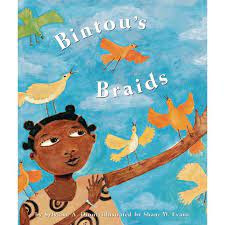
• Meet Bintou in Bintou's Braids by Sylvaine Diouf.  She wants braids. Long, pretty braids, woven with gold coins and seashells, just like her older sister and the other women in her family. But she is too young for braids.

• Meet Beatrice in Beatrice's Goat  by Page McBrier. More than anything, Beatrice longs to be a schoolgirl. But in her small African village, only children who can afford uniforms and books can go to school. Beatrice knows that with six children to care for, her family is much too poor. But when Beatrice receives a wonderful gift from some people far away -- a goat she names Mugisa (which means "luck") who gives milk that Beatrice can sell. With Mugisa's help, it looks as if Beatrice's dream may come true after all. 

• Meet Saruni in My Rows and Piles of Coins by Tololwa M. Moller. Saruni is saving his precious coins for a red and blue bicycle. How happy he will be when he can help his mother carry heavy loads to market on his very own bicycle--and how disappointed he is to discover that he hasn't saved nearly enough! 

• Meet Mustafa in My Father's Shop by Satomi Ichikawa There is a rug in his father's  shop in Morocco that Mustafa loves. Mustafa s father would like him to know some words in other languages too, and he tells Mustafa that he may have the rug if he agrees to learn. He finds a very different way of learning foreign languages...and of getting tourists to visit his father's shop. This book will really make you smile. Read this alongside Jeannie Baker's Mirror.

• Meet Fatima in Gogo's List by Portia Derry. Fatima is a young girl in Ghana who is determined to save the day. She wants to help Gogo with her to-do list so that everyone will realise that she is a big girl now! But things don’t go exactly as expected ... 

• Meet Kondi in Galimoto by Karen Lynn Williams. Kondi is determined to make a galimoto -- a toy vehicle made of wire. His brother laughs at the idea, but all day Kondi goes about gathering up the wire he needs. By nightfall, his wonderful galimoto is ready for the village children to play with in the light of the moon.

• Meet Gie Gie in The Water Princess by Susan Verde. Gie Gie is inspired by the childhood of African-born model Georgie Badiel. Clean drinking water is scarce in her small African village. And try as she might, Gie Gie cannot bring the water closer; she cannot make it run clearer. Every morning, she rises before the sun to make the long journey to the well.

• Meet Jojo in Jojo's Wire Car by Veronica Lamond. Jojo is a busy little boy who lives with his granny in East Africa.He is expected to help with the chores, do well in school and also help earn money. One day, a Wire Car Competition is announced and, along with all the other village children, Jojo enters to try to win the prize.

• Meet Fatou in Fatou, Fetch the Water by Neil Griffiths. Fatou appears to be a very forgetful child. The story is set in the smallest country in Africa, The Gambia and the picture book contains a section of facts about the cultures and traditions of this colourful nation, so you can learn as well as enjoy.

• Meet Penda in  in Don't Spill the Milk  by Stephen Davies. Penda carries a bowl of milk on her head across dunes and the River Niger, and even up a mountain, without spilling a drop despite many distractions. She gets a surprise when she arrives at the grasslands to give her father his lunch. 


Of course the library has others too:


Wednesday, June 14, 2023

17th June Global Garbage Man Day


Yes, a day to celebrate your garbage men. They do a fabulous job of making sure your environment is clean and rubbish free. A study has estimated that Sanitation work is one of the most dangerous and hazardous jobs. The odours could make the workers sick, a broken glass may slit, and inhaling dust may lead to respiratory problems. Not many of us would volunteer for this job.

A key to developing a child's lifelong love for reading is by reading them books about their interests. And this starts from the time they are toddlers. It's not uncommon for preschoolers to develop a kind of obsession with a particular topic and this can be garbage trucks.

The young students I teach are far more interested in the garbage trucks than the men that arrive with them. This fascination starts very young. If you ask a three year old what day the garbage truck comes they will be able to tell you. It is on their weekly agenda. This is the blurb from Benji's Garbage Trucks by Roberta and Benji Cocking.

All young children look forward to their weekly visit and garbage pickup by their garbage/sanitary trucks and drivers. For Benji Cocking, everything about the arrival of the garbage truck for the weekly trash pickup is exciting! Taking out the trash, the excitement of seeing the truck and his favorite driver, the driver honking the horn, watching the powerful robotic arm lifting the trash bin and dumping the trash, and the trash shattering into the compactor and being smashed are what Benji anxiously looks forward to every week. If you love garbage trucks, you will love the pictures Benji has gathered for you in this book!

In Australia we have Rajah Street  by Myo Yim which tells a similar story. Junya loves to sit at his window and watch the goings-on in Rajah Street. He  thinks Wednesdays are the best days, because that is when the garbage trucks come.

If you choose to embrace this strange fascination  then gather a collection of books about garbage trucks, garbage an the people who collect it. They will make a great display.

• The Garbage Trucks are Coming Today by Susan Taylor and Christian  Bocquee A fun read for any child who loves garbage trucks.

• I Stink  by Kate and Jim McMullan

• Trashy Town  by Andrea Zimmerman, David Clemesha and Dan Yaccarino

• Supertruck by Stephen Savage

• Hooray for Garbage Collectors  by Tessa Keenan

• Garbage Collectors  by Laura K. Murray

• Garbage Trucks  by Quinn M. Arnold

• Trash Truck  by Max Keane

• Garbage Trucks on the Go by Beth Bence Reinki

• If You Were a Garbage Truck  by Diane Ohanesian and Joey Chou

• The Story of Rubbish  by Katie Haynes

• What a Load of Rubbish!  by Riley Flynn

•  How a Recycling Truck Works by Lara Bryan and Giovana Medeiros

•  Here Comes the Garbage Barge  by Jonah Winter

• Green Machine by Rebecca Donnelly and Christophe Jacques


Monday, June 12, 2023

15th June Global Wind Day

Global Wind Day is a worldwide event that occurs annually on 15 June. It is a day for discovering wind energy, its power and the possibilities it holds to reshape our energy systems, decarbonise our economies and boost jobs and growth. 

The wind is a vitally important phenomenon that has been used throughout history in many ways. Its power has inspired mythological tales and has given names to gods. Its existence regulates the Earth's temperature, shapes the relief, enhances biodiversity by dispersing seeds and, in addition, its thrust has become a source of energy, from the time when it pushed sailing ships across the seas to the present day, where it is an energy resource that is becoming more and more important.

Wind is moving air and it is caused by differences in air pressure  within our atmosphere. Air under high pressure moves toward areas of low pressure. The greater the difference in pressure, the faster the air flows. 

Winds have different levels of speed, such as “breeze” and “gale”, depending on how fast they blow. Wind speeds are based on the descriptions of winds in a scale called the Beaufort Scale. Some of a child's vocabulary is based on wind...gust, waft, blow, draft, tornado, gale... and knowing what differentiates them.


In 1810, a British naval officer and surveyor named Francis Beaufort developed a scale to give sailors a common language for describing the wind. From 0 (calm) to 12 (hurricane). 
You can read about this scale here:

• Close to the Wind by Peter Malone

• Hear the Wind Blow  by Doe Boyle and Emily Paik

• Wild is the Wind  by Grahame Baker-Smith

• Wind  by Olga Fadeeva and Lena Traer

• Feel the Wind by Arthur Dorros

• I Face the Wind  by science book writer Vicki Cobb and Julia Gorton shows a young girl demonstrating the properties of wind through her own observations and a series of easy-to-read-and-do activities and experiments, using common household materials.

• Energy Island by Allan Drummond is the story of Samso, a windy island in Denmark. The environmentally friendly inhabitants of this island now proudly call their home Energy Island as a result of their work with wind power. 

People have harnessed the power of the wind for thousands of years, to travel by sailboat, to cool homes, to grind grain into flour, and even to make music. But when someone hooked a wind mill to a generator, wind went electric, unlocking the secret to a clean, renewable energy source.

• Wind Power  by Laura Driscoll is a biography about wind.

• Generating Wind Power  by Niki Driscoll is a more traditional nonfiction text.

• The Boy Who Harnessed the Wind by William Kamkwamba and Elizabeth Zunon is the story of when fourteen-year-old William Kamkwamba's, Malawi village was hit by a drought and  everyone's crops began to fail. Without enough money for food, let alone school, William spent his days in the library . . . and figured out how to bring electricity to his village.

• Electric Wind: The Story of  William Kamkwamba by Kerrie Shanahan

Kites, birds, and airplanes all require the power of wind to fly, but they all use it in different ways.

• Flying High With Wind  by  Goo-Reum Seo and Joo-Mi Lee

• Kate, Who Tamed the Wind  by Liz Garton Scanlon and Lee White tells the story of Kate who plants trees as a wind break in order to help a man troubled by wind.

Stories also show the power of the wind. The fable about the sun and the wind trying to remove a man's coat demonstrates this and is the topic of many picture books such as:

• The Contest Between the Wind and the Sun  by Heather Forest and Susan Gaber

• The North Wind and the Sun  by Brian Wildsmith

and soon to be 

•  The North Wind and the Sun  by Philip C. Stead

• Mrs Mopple's Washing Line  by Anita Hewett  and Robert Broomfield

• The Wind Blew by Pat Hutchins

• Peggy by Anna Walker

• The Windy Farm  by Doug McLeod and Craig Smith

Then you can explore kites, hurricanes, tornadoes, twisters, windmills ... the list goes on.

For fun, revisit the adage When the Wind Changed using Ruth Park and Deborah Niland's picture book or revisit another oldie but goodie Gilberto and the Wind by Marie Hall Ets

Not enough? Look here.


And, why would a bird be called Windcatcher in the book of that name by Diane Jackson Hill and Craig Smith, and can the wind whisper? See Mizuto and the Wind by Kaye Baillie and Luisa Gioffre-Suzuki which explores the Japanese concept of the wind telephone.


Do you like the wind? As a teacher, I do not as it really winds the students up, but if I am tucked up safely at home it amazes me the power it can exert.


Sunday, June 11, 2023

14th June International Bath Day

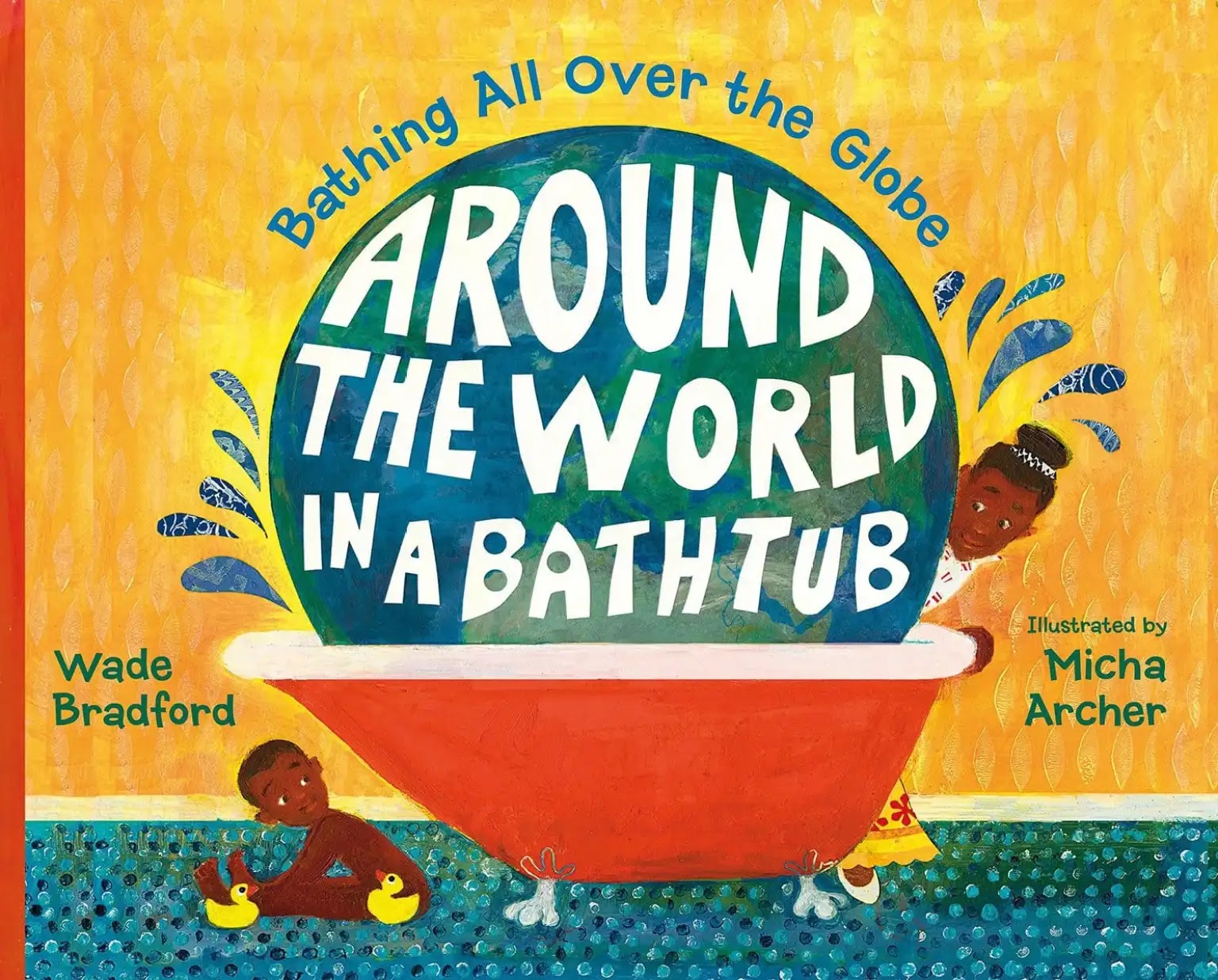
I haven't written about International Bath Day since 2017. This is a reminder that baths feature in so many children's books that it is a wonderful topic for a display.

Not only are baths excellent for relaxing and unwinding, places of mindful rejuvenation, but  they can also be the catalyst for great discoveries and decisions.

Throughout the ages there is a long history of momentous baths! One of the most ancient, and famous, of these is the origin of International Bath Day. Legend says that it was on this day (14 June) over 2200 years ago, that the Greek mathematician, physicist, engineer, inventor and astronomer, Archimedes enjoyed a contemplative bath. While he prepared the bath, he mulled over a problem that had been assigned to him by Hieron, the King of Syracuse. This bath resulted in Archimedes Principle. See short video or better still read Archimedes Bath  by Pamela Allen and get students to work it out for themselves. 


Other famous bath-takers include the English Prime Minister Winston Churchill, President William Howard Taft and Queen Victoria.   


When it comes to bath time with children, it can be one of two things

1. exciting, fun,  a great place of discovery and learning. With just a few simple bath toys or cups and containers, they will play with the water and naturally learn basic physics such as empty, full, floating,  sinking, and cause and effect.

This book looks at how the bath feels!


2. a nightmare because the recipient does not want to have a bath.


Many bath time books feature animals. Why? Is it an attempt to convince children that everyone bathes and it can be lots of fun! Harry the Dirty Dog, Paddington, The Pigeon Needs a Bath, Pig the Grub all need to be bathed! See this  Pinterest page for other suggestions.

Sometimes the bath is magical!

The Flying Bath  by Julia Donaldson and David Roberts

There's a Pharaoh in Our Bath! by Jeremy Strong

Time to get Out of the Bath, Shirley  by John Burningham

Sometimes the bath is in a bathroom, but sometimes it is outside or communal.

 Alexander and the Terrible, Horrible,No Good, Very Bad Day by Judith Viorst and Ray Cruz

The Big Bath House  by Kyo Maclear and Grace Zhang is a celebration of Japanese culture. A small girl goes with her aunties and grandmother to a traditional bath house.


In Unplugged by Gwenda Millard and Dee Huxley, Grandma Mabel is unable to use the inside bath because of bees, so instead bathes outside in Murray's bath under the plum tree. She loses her bathwater and clothes... 


With lots of bubble bath? It is Bubble Bath Day on 8th January!

How to Wash a Wooly Mammoth by Michelle Robinson and Kate Hindley

Giraffe in the Bath by Men Fox, Olivia Rawson and Kerry Argent

What are my favourites? As a mother and someone who loves reading in the bath: Five Minutes Peace by Jill Murphy. Reading this with young children always makes me smile. They are sure five minutes is a long time! They also love that the children all get in the bath too.

For older students, I've enjoyed reading Harry the Poisonous Centipede by Lynne Reid Banks. The thought of anything coming up the plughole always starts great discussion about whether it really is possible.

Time to start collecting all those bath books for a display!


Thursday, June 8, 2023

10th June Worldwide Knit in Public Day


Worldwide Knit in Public Day is celebrated on the second Saturday of June every year. The objective of the holiday is to showcase knitting as an enjoyable activity to partake in — for all ages, not just doting grandparents looking to make a sweater for their darling grandchildren. The day brings with it a sense of community for knitters, who often celebrate together by knitting in public spaces to make their hobby more visible and accessible to the public. It’s also a day for experienced knitters to teach others how to knit. Worldwide Knit in Public Day was founded in 2005 by knitting enthusiast Danielle Landes whose goal was to get all the closeted knitters out into the fresh air. It remains the world’s largest knitting event. Coincidently it is also Yarn Bombing Day on this day or the 11th June depending where you read.Yarn bombing is simply the practice of knitted works of art being added to public places. For example, a yarn bomber may design some sort of colourful knitted pattern and wrap it around a tree. The aim of this practice is to try and take knitting from something that is viewed as merely for creating clothes and hats to something that could add meaning and colour to urban locations.

Knitting happens to be one of the oldest ways of making clothes. The earliest known accounts of knitting date it back to — at least — fifth-century Egypt. Egyptians used to knit cotton fibers, not wool.

Knitted weatherproof sweaters for sailors became relatively common in the 14th century. The advent of the Industrial Revolution brought with it the automation of tasks — knitting was no different. Knitting machines began being used to knit hosiery for the elite. A local knitting industry slowly emerged in Scotland, which began the production of knitted stockings for circulation across Europe. The first knitting loom was built in 1816, and the first ever woolen textile factory was opened in 1856 by Eugene Rodier.

How to celebrate these days? Knit! In public! If not, read about knitting. You will be surprised by how many picture books for children feature knitting. Even when the book is not overtly about knitting, a character will be knitting, showing readers that lots of people knit for a hobby.


As a person who can knit, I always notice the knitters in books, but I must say since I read Betsy Bird's article about knitters in books, I am looking at those knitters anew. She says that this book, Knitting For Dogs shows that the writer illustrator, Laurel Molk is definitely a knitter because she has the needles positioned correctly and we see the fingers and the wool clearly. Not all of the books featured here will do that, but that doesn't mean they're not worth reading.


There are nonfiction books designed to teach children to knit, but they are no replacement for a patient adult or older child,  a pair of thick needles and some thickish wool. A person can show you how to hold the needles and get your hands working together with the wool. Start with a scarf. It happens fast! Be inspired by Little Owl's Orange Scarf. We suggest a toy owl in the library needs an orange scarf. What a challenge?


Others to look for:


Now I'm off to knit in public! I'll sit in a park, gets some fresh air and see who joins me.