Friday, January 26, 2024

26th January National Spouses Day


John Burningham and Helen Oxenbury were jointly presented with the Book Trust Lifetime Achievement Award, which celebrates the body of work of an author or illustrator who has made an outstanding contribution to children’s literature. This is not usually a joint award, but these two well-known creators of children books were a couple and today we celebrate spouses!


While this is an American 'celebration' it did make me think of just how many couples there are in the world of children's literature, some who work together, others that work separately but both 'make' books. I always think that the discussions they have about books must be amazing and the combined knowledge so useful.

The children I teach are young and 'spouse' is not a word they use in everyday speech. They don't use 'sibling' either although many of them have siblings. They just refer to them as sisters and brothers.

I remember using the word when we talked about 'husband' and 'wife' prior to a visit to the school by Kate and Jol Temple, the students telling me that 'it's a funny word that rhymes with house'.

Often we might display spouses books together in the one display and ask the students to say why these books are together? They are quick to answer when they have the same surname, such as Ken and Ruth Brown, Philip and Laura Bunting,  Erin and Philip Stead but it is harder when they have different names, such as John Burningham and Helen Oxenbury, Jacky Davis and David Soman, Sue Hendra and Paul Linnet, Robin Page and Steve Jenkins, Sarah Stewart and David Small, Anna King and Christopher Weyant, Marie-Louise Fitzpatrick and Michael Emberley. This is a sample, but there are so many to study the work of and read.

Steve Jenkins and Robin Page


Anna Kang and Christopher Weyant


Sue Hendra and Paul Linnet


Laura and Philip Bunting


Erin and Philip Stead


Sunday, January 21, 2024

21st January Squirrel Appreciation Day


It is very easy to appreciate squirrels when you have very little knowledge of them and for you they are the lovely looking mischievous characters in children's picture books. But I get the feeling that for people who live with them, they may well be like possums are for me where I live...pests!

Squirrels are found almost everywhere on Earth. They are native to Africa, the Americas, Europe, and Asia, but not here in Australia.

In North America, the western and eastern grey squirrels are very common. In Europe, the red squirrel is more common, but its numbers in Great Britain and Ireland are decreasing. The decrease in the red squirrel population is linked to the introduction of the eastern grey squirrel from North America. I experienced this firsthand in September while visiting Cornwall. We were holidaying in a barn not far from Trewithen, a magnificent old garden estate where they are endeavouring to restore the garden and breed red squirrels in captivity in order to increase their numbers. I was very excited, thinking I was going to see some red squirrels, but alas we did not. Never mind, I still think their plans are  worthwhile.

Squirrels do appear as book characters a lot! See here, but given how cheeky they seem to be they have become particularly popular as characters for ongoing series, many of which are in graphic novel format.

These series are in my school library:

Bear and Squirrel by Smitri Halls and Steve Small (3)


Newton and Curie The Science Squirrels by Daniel Kirk (2)


Norma and Belly by Mika Song (4)


Jonathan Fenske Nuts! (2)


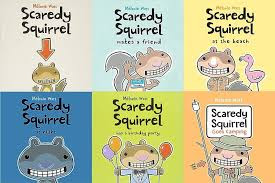
Scaredy Squirrel  by Melanie Watt
Picture books (7)


Nutty Adventures (graphic novels) (4)


Squirrels Unlimited  by Mo Willems (5)


Twitch the Squirrel series by Vivian Vande Velde and Steve Bjorkman (4)


Bird & Squirrel by James Burks  (7)


The Dead Sea Squirrels by Mike Nawrocki and Luke Seguin-Magee (9)


And coming later in 2024, Book 1 of a new graphic series by Luke Seguin-Magee.


Saturday, January 20, 2024

23rd January Starting School


These three books show three different perspectives on starting school and the school stakeholder's expectations.

Mr S  by Monica Arnaldo

It was the first day of school. But even the kindergarteners of room 2B could tell something was seriously wrong. . . . Where was the teacher? Who left this sandwich on the desk. The only clue, written on the chalkboard, was the three simple letters: Mr. S

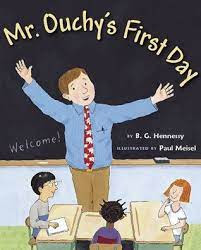
Mr Ouchy's First Day by B.G. Hennessy and Paul Meisel

Mr. Ouchy is nervous about his first day of school . . . even though he’s the teacher! Will his students like him? Will he be able to find the bathroom? What if he can’t remember his students’ names? Fortunately, his classroom keeps him busy; his students have plenty of their own questions, and the first day of school turns into a great day discussing things like Mr. Ouchy’s funny name, how long a minute really lasts, and what everyone wants to learn in the upcoming year—things like whistling, playing drums and drawing dinosaurs.

School's First Day of School by Adam Rex and Christian Robinson

It's the first day of school at Frederick Douglass Elementary and everyone's just a little bit nervous, especially the school itself. What will the children do once they come? Will they like the school? Will they be nice to him? The school has a rough start, but as the day goes on, he soon recovers when he sees that he's not the only one going through first-day jitters. 

These three books are FUN! They help students laugh away first day jitters. They reassure students that they are not alone. They remind older students what starting school is like. Yet, they will not appear on a list of books for Kindergarten teachers introducing school to their new class. Next week when four new Kindergarten classes go into their new rooms with their new teachers in NSW they are more likely to be following a published English unit which has suggested texts.

The NSW Early Stage 1 English Unit for the start of school looks at Context by looking at the topic Starting School. These three books are not their reading suggestions. I do wonder why? At the school I teach at most of the kindergarteners have done at least two years of preschool on the same campus as their Kindergarten classroom, in a very similar uniform and with older brothers and sisters who are there so they have visited frequently. Even those who haven't, have been to some form of preschool or community long day care. Most have professional parents who value education and do all the right things to ready their child for school, including sharing 'starting school books' from the library.

My other problem is that at my school there are four Kindergarten classes and they all want the same library book as a mentor text on the same day! And if you have four copies they will only be used in those two weeks and then sit on the shelf...not a good use of resources and not good in my context because the library shelves are very full.

I have tried talking about how these texts are suggestions only and how you could still meet the outcomes using other texts. I have also talked about how the suggestions are 'products of their time' and that new books have been published since, that would work or that the library has older out of print texts that also could work. The units are only as good as the unit writers' knowledge of children's books and what is available to them. 

So please embrace the concept of companion texts. What do I mean by a companion text? A book that has a similar theme, context, set of characters, and / or similar Tier 2 vocabulary. It may suit your cohort better because you are teaching a group of more diverse students and you want them to see themselves in the text. It may be less or more complex depending upon your students prior knowledge and school experiences. It may just be an extra book that you read during the week. Please look widely, search out alternatives, speak to your teacher librarian for suggestions, look online at what other teachers have used.

The unit suggests you use these two books:

Starting School  by Jane Godwin and Anna Walker

Little Nic's Big Day  by Nic Naitanui and Fatima Anaya

and while both of these books are excellent, these are some companion texts worth looking at:

The Starting School List by Kitty Black and Cate James

First Day by Andrew Daddo and Jonathan Bentley

Mae's First Day at School by Kate Berube

Jessica's Box  by Peter Carnavas

My First Day at School  by Meredith Costain and Michelle Mackintosh

Ozzie Goes to School by Jocelyn Crabb and Danny Snell

and there's other starting school titles here.

The unit then recommends

Families by Jane Godwin and Yael Frankel

This is a very 'simple' look at families and it may not suit your needs.

If you would like a wider more diverse view of families try these:

Who's in My Family?  by Robie H. Harris

Big Book of Families by Catherine and Laurence Anholt

All About Families  by Felicity Brooks and Mar Ferrero

Isla's Family Tree  by Katrina McKelvey and Prue Pittock

and then look here.


Friday, January 19, 2024

20th January Back to School

Nearly time to be back at school. I know that next week teachers who have been planning during the holidays will come to the library to get books to read with their new classes which will be provocations for class discussions about, composing their class agreements, everyone's expectations, setting rules and routines. The first few weeks of school are so important for this as it helps set the tone for the rest of the year. Teachers often need to model the desired behaviours and let students practise them until they become second nature. I know good picture books can  help make this process a little more enjoyable because  sometimes laughing at someone else in a book has a way of getting through when your words cannot.


Besides specific nonfiction books such as Rules and Responsibilities by Louise Spilsbury and Why Do We Have Rules? by  Jane Pearson,  it is sometimes just fun to start with a story about someone who has trouble with rules. See:

The Day the Banana Went Bad by Michelle Robinson and Tom Knight

Princess Smartypants Breaks the Rules!  by Babette Cole

Monster School Rules by Rory H. Mather and Carla Martell

David Goes to School  by David Shannon

For  young students these are good:

Our Classroom Rules!  by Kallie George and Joy Fleck

Our Playground Rules! by Kallie George and Joy Fleck


I have written about this before here. And there are other suggested titles here


Thursday, January 18, 2024

22nd January Answer Your Cat's Questions Day 3 (Cat vs Dog)


Often when teachers borrow cat and dog books it's because they want their students to write or debate persuasively about which is the better pet. As well as giving them books that specifically address this, there are so many series of books available where there is a dog and a cat. Can they really be friends?


Series that feature a cat and a dog:

Cat and Dog  by Jonathan Bentley (3 picture books)


Mack and Cheeze by Chrissie Krebs (3)


See the Dog; See the Cat; See the Dog; This is Ghost by David Rochelle (3)


Pepper and Boo by Charise  Mericle Harper (3)


Jasper and Scruff by Nicola Colton (4)


Weenie Featuring Frank and Beans by Maureen Fergus (2)


•  Peanut Butter and Crackers by Paige Braddock (5)


Houndsley and Catina  by James Howe (6)


The Underdogs by Kate and Jol Temple (4)


And two stand-alone short chapter books worth reading:

Diva and Flea by Mo Willems


Archie and Archie by Ruth Rendell