It is World Turtle Day! The purpose of this day is to bring attention to, and increase knowledge of and respect for turtles and tortoises, and to encourage human action to help them survive and thrive.


World Turtle Day is celebrated on 23rd May.
Turtles are omnivore reptiles characterised by a shell made from bones, developed from their ribs, covering the body. Turtles can be terrestrial or live in freshwater or the sea. Their main threat is being killed as bycatch in fishing nets, and disappearing habitats.
I have written about Turtle Day before, but recently the library has purchased some new books that feature turtles.
Green Sea Turtle by John Lesley
Find out about the mysterious life of the green sea turtle and why we need to stop it becoming extinct in this new addition to the Australia's Remarkable Wildlife series.
The Book of Turtles by Sy Montgomery & Matt Patterson
An ode to one of the most diverse, fascinating, and beloved species on the planet: turtles. With dazzling illustrations and emotionally engaging, fact-filled text, this picture book will speak to the wisdom these long-lived animals can lend.
Book 3
The Turtle Who Turned the Tide by Rachel Bright & Jim Field
On a midnight-black beach, it's time for a grand hatching. A rowdy crowd of animal onlookers have gathered to see which baby turtle will win the great race to safety in the sea, but when Tula's brother loses his way, this baby turtle faces a difficult choice: will she choose to win the race or will she turn back to rescue her brother?
And last weekend I went to Gleebooks to hear Anna Walker talk about her new book, The Dream Keeper.
Book 4
In a small boat, the turtle sets off on a journey to deliver dreams in the nearby city. Meanwhile, a young girl, scared in the night by the shadows in her room, finds comfort in her toys ... but cannot sleep.
As the two stories unfold side by side, the young girl and the intrepid turtle must each harness their courage and overcome their fears as their worlds collide in the most wonderful, magical way.
For more wonderful turtle picture books see my Pinterest or put 'turtles' in the search of my blog.
I have written about this day before here and here, but in our school library this is a day when no matter what I put on display, the books all seem to get borrowed. This topic is nearly as popular as polar bears and pandas so the library has a number of fiction and nonfiction titles. See my Pinterest page. The book pictured A Turtle's View of the Ocean Blue by Catherine Barr and Brendan Kearney is truly inspiring and fairly new so if you are short of turtle books, consider this one. The day after Turtle Day Lindsay Moore's new book, Yoshi and the Ocean will be released. It is based on a real turtle who was released from captivity in South Africa, but then was tracked travelling thousands of miles. What amazing creatures turtles are!
If tortoises are of more interest, two must reads are Jean Craighead George's Galapagos George (also based on a real creature) or Paul Geraghty's Tortuga are worth hunting for in a library.
In the last year though, three books have been published about a 'famous' loggerhead turtle, Yoshi who has made her home on the north western coast of Australia after a very long swim. Yoshi was released off the Cape Town coast in 2017 by Two Oceans Aquarium, an institution who had cared for her for twenty years since she was given to the aquarium in 1997 by a Japanese fishing boat captain because she was injured.
With modern satellite tracking technology in collaboration with the government and donors, Two Oceans Aquarium was able to follow along with Yoshi to map her progress and understand the sights she saw along the way. In her swim was equivalent to nearly 1.5 million lengths of a 25m Olympic size swimming pool.
Kids News has an entry about Yoshi that gives students the information in a factual manner, but these three books give students the facts embedded in a narrative and with beautiful illustrations. 'Discover an amazing story celebrating teamwork, science, and an animal hero who swam more than 22,000 miles to her true home--the longest journey of any animal ever tracked. In addition to being awe-inspiring, Yoshi's story underlines the importance of wildlife conservation and the power of one animal to unite people around the world for a common cause.' This could be the blurb for all three!
• Yoshi and the Ocean by Lindsay Moore
• Yoshi's Big Swim by Mary Warley Copp and Kaja Kajfez
• Yoshi Sea Turtle Genius by Lynne Cox and Richard Jones
The library is well-equipped with 'true' animal stories. These are a great way to show students what is happening in the world to save animals from harm.
I have highlighted this day before here and here, but although our supermarkets and many other shops no longer have single use plastic bags, there is still a problem and more and more picture books for very young children seem to want to 'hammer' home the message. One of the library staff thinks we are scaring our preschoolers? Are we? I'd like to know what effect they have.
In the library we have:
• Bag in the Wind by Ted Kooser and Barry Root
One cold morning in early spring, a bulldozer pushes a pile of garbage around a landfill and uncovers an empty plastic bag — a perfectly good bag, the color of the skin of a yellow onion, with two holes for handles — that someone has thrown away. Just then, a puff of wind lifts the rolling, flapping bag over a chain-link fence and into the lives of several townsfolk — a can-collecting girl, a homeless man, a store owner — not that all of them notice.
• Jelly-Boy by Nicole Godwin and Christopher Nielsen
What happens when a jellyfish falls in love with a plastic bag she mistakes for a jelly-boy? Jelly-Boy is different. He is big and strong. And not as wobbly as the other Jelly-boys. By the time Jelly-Girl discovers the dangerous truth about her new friend, it may already be too late.
• Saving Seal by Diane Jackson Hill and Craig Smith
Lizzie and Grandpa Dave are motivated to do something about cleaning up their Bay and saving the marine life who are being threatened more and more by the rubbish found in the Bay and on their beaches. They encourage the towns people to join them in their fight against plastic pollution devastating their beaches and harming marine life.
• Little Pago by Lauren Briggs
Little Pago and his friends set out on an adventurous journey in search for food, but not everything floating in the ocean is safe for a baby turtle to eat. A plastic bag is easily mistaken for some of Little Pago's favourite food. Little Pago is a mascot for the welfare of all Australian sea turtles and shines a light on one of the critical threats that face sea turtles, plastic waste in our ocean. It encourages readers to challenge the way we live, so that collectively we can work towards preventing these majestic sea creatures becoming extinct.
• Little Turtle and the Changing Sea by Becky Davies and Jennie Poh
Little Turtle loves the ocean with her whole heart. As the years pass, she repeats an incredible journey across the world to the beautiful coral reefs. But one day she finds that plastic has invaded her beloved ocean. Could Turtle's journey be over forever?
• A Bag and a Bird by Pamela Allen
This is a story of a plastic bag and a bird - a cautionary tale about taking care of our environment as well as being a wonderful showcase of some of the famous sights of Sydney.
• Somebody Swallowed Stanley by Sarah Roberts and Hannah Peck
Most jellyfish have dangly-gangly tentacles, but Stanley has two handles...
• One Plastic Bag: Isatou Ceesay and the recycling women of Gambia by Miranda Paul and Elizabeth Zunon
For years, plastic bags were a cheap and convenient option for carrying goods in Njau, Gambia. However, when these bags broke or were no longer needed, they were carelessly discarded, leading to an unsightly accumulation of plastic waste alongside roads. Isatou Ceesay decided to take action, and she began to collect the plastic bags and recycle them into something new. Her efforts not only helped to clean up the environment, but also provided income for women in her community who had been struggling to make ends meet.
There has been so much talk about going without plastic bags that even the five year olds I teach can tell you why we should. We live near the water, so these children spend a lot of time at the beach, on boats and in the water. They know about the damage they cause in the ocean especially to turtles, but it is always a topic that needs revisiting, so when I saw this new book at the bookshop I purchased it for the library. Someone Swallowed Stanley by animal behaviourist and wildlife expert Sarah Roberts reiterates this important message about turtles and plastic bags and it has a child as the wildlife hero. It also has fun illustrations by Hannah Peck who seems to have enjoyed giving all the sea animals anthropomorphic mannerisms. If you are looking for other books about plastic bags see this earlier entry in my blog.
International Horseshoe Crab Day is observed on 20th June, raising awareness of this "living fossil," a marine chelicerate arthropod living in shallow coastal waters on soft sandy or muddy bottoms. Its existence is critical to coastal biodiversity, as horseshoe crabs lay millions of eggs on beaches to feed shorebirds, fish, and other wildlife. Besides, their large hard shell serves as microhabitat for species such as sponges, mud crabs, mussels, and snails. Yet, their population is at risk due to overharvesting, and habitat loss.
Our library doesn't have any horseshoecrab books, so there will be no display, but when I saw that there was a day to think about them I remembered reading about how High Tide for Horseshoe Crabs was an honour book in the Bank Street Cook Prize for STEM picture books in 2016. I had never heard of horseshoe crabs until I saw this book. It was on so many lists of books to read that were published in 2016, so I thought I had better find out about them and whether we had any in Australia. There are no Horseshoe crabs in Australia now. They used to live in Australia and have been found here as fossils.High Tide for Horseshoe Crabs by Lisa Kahn Schnell and Alan Marks introduces the life cycle of the horseshoe crab, with a focus on the annual mass-spawning event at Delaware Bay.
It is National Serpent Day. What is a serpent? A snake, so it is Snake Day! Some websites say it is Snake Day on the 16th July so you can celebrate again then. There are lots of words for 'snake' that children recognise, like adder, asp, python, cobra and boa constrictor. What ever name they have many of the boys I teach are fascinated by them and snake books are well borrowed. In fact, at the moment the display shelves of the library are saturated with reptile books in three sections: snakes and lizards, crocodiles and alligators and turtles and tortoises. The library has only been open for two days and already quite a few snake and crocodile books have gone.Darwin Day is a celebration to commemorate the birthday of Charles Darwin on 12 February1809. The day is used to highlight Darwin's contributions to science and to promote science in general. Darwin Day is celebrated around the world, but for Australians, Darwin has a special place as he visited in 1836 and it was Australian flora and fauna that got Darwin thinking about why our animals are so different.
Sydney was just one of many ports of call for the Beagle on its five-year round-the-world surveying voyage. Before departing the antipodes two months later, Darwin was to have a revelation that would eventually inform his grand theory of evolution by natural selection. Read this article.
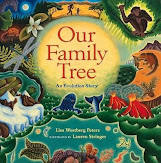
Talking about Charles Darwin with students always elicits much discussion about his work and there are always requests for books so they can read more. These books are a good start but there are many picture books on evolution that are easy enough for eight year olds to begin an interest in evolution.
This book follows the journey of HMS Beagle, showing life on-board the ship for Darwin, the captain, crew and the expedition's artist. The reader sees Darwin discovering and observing insect life in Brazil, fossils in Argentina , earthquakes in Chile and turtles in the Galapagos Islands. The reader is therefore able to follow the steps which led to Darwin's inspired theory of evolution.
In 1831 a 22-year-old naturalist named Charles Darwin stepped aboard the HMS Beagle as a traveling companion of an equally youthful sea captain called Robert FitzRoy. The Beagle's round-the-world surveying journey lasted five long years on the high seas. The young Darwin noticed everything, and proved himself an avid and detailed chronicler of daily events on the Beagle and onshore.
In 1831, Charles Darwin embarked on his first voyage. Though he was a scientist by profession, he was an explorer at heart. While journeying around South America for the first time aboard a 90-foot-long ship named the Beagle, Charles collected insects, dug up bones, galloped with gauchos, encountered volcanoes and earthquakes, and even ate armadillo for breakfast!
Charles Darwin's On the Origin of the Species by Sabina Radeva
A picture book adaptation of Charles Darwin's groundbreaking On the Origin of Species, lushly illustrated and told in accessible and engaging easy-to-understand text for young readers.
On 24th November 1859, Charles Darwin’s On the Origin of Species was first published, selling out almost immediately. Describing the now well known theory that humans evolved through a process called natural selection, it became an instant classic and cemented Darwin as one of the greatest biologists of all time. However, he couldn’t have done it without the support, encouragement and advice from those who believed in him. None more so than Joseph Hooker, his friend, confidant and fellow collector, who supported and helped Darwin when he didn’t dare ask anyone else.
Biographies such as these and picture books that explain evolution in more simple ways for a young audience.