Showing posts with label Anthony Browne. Show all posts

Tuesday, December 10, 2024

Primates, Apes, Monkeys?


Yesterday when I was writing about monkeys, I got so confused about what was a monkey, strictly speaking. Then what is an ape? And what is a primate? So just as I did for Big Cats I went on a search to sort my thinking out.

A primate is any mammal of the group that includes lemurs, lorises, tarsiers, monkeys, apes and humans, so there are primates other than apes, monkeys and humans.

One major difference between apes and monkeys is that apes have no tails, and almost all monkeys have tails, so the quickest and easiest way to tell a monkey and an ape apart is by looking for a tail. Apes are also typically larger than monkeys, as is demonstrated in the size of gorillas and orangutans. 

The gorilla, chimpanzee, bonobo and orangutan are called great apes in recognition of their comparatively large size and humanlike features; the gibbons are called lesser apes. The great apes are much more intelligent than monkeys and gibbons. Apes also tend to live longer than monkeys. Martin Jenkins book above will help solve these questions.

Monkey species include baboons, macaques, marmosets, tamarins, and capuchins. Ape species include humans, gorillas, chimpanzees, orangutans, gibbons, and bonobos. In evolutionary and genetic terms, ape species are much closer to humans than monkeys are.

Most of the apes have a celebratory day of their own and are easier to celebrate with picture books. Anthony Browne has made that very easy because so many of his picture books feature gorillas or chimpanzees, but not so sure about books about bonobos and gibbons. I know very little about bonobos, but when you read about them here as I did you realise we should know so much more about them as they share a remarkable 98.7% of our DNA, making them our closest living relatives. Bonobos are biologically conditioned to look for peaceful solutions, unlike their more rambunctious cousins, the chimpanzees so they are often referred to as peace ambassadors and they share their day with Valentines Day.

World Gorilla Day 24th September.

World Chimpanzee Day is 14th July.

World Bonobo Day is 14th February.

World Orangutan Day is 19th July.

World Gibbon Day is 24th October.


Friday, October 27, 2023

31st October Doorbell Day


On October 31st, National Doorbell Day will have doorbells ringing more than any other day of the year. The day recognises the little buzzer, unique tones, and rings that alert us to visitors to our doors every day of the year. And, of course on Halloween the doorbell will be rung more than usual, in fact more than on any other day of the year. 


Joseph Henry invented the first electric doorbell in 1831 and during the Great Depression, J. Ralph Corbett invented doorbells that feature different chimes. 

Of course, we can celebrate this day with Halloween picture books, but I want to draw your attention to books that are specifically about or feature doors, knocking and or doorbells.


Probably the most well known is The Doorbell Rang  by Pat Hutchins which looks at all the visitors sharing a plate of freshly cooked cookies.


And there is a lovely new book titled Knock Knock  by Catherine Meatheringham and Deb Hudson which takes the onomatopoeic word knock and gives it in other languages as well. 


There are others. This is what I can think of, but I'm sure there are others...

Knock Knock Who's There?  by Sally Grindley and Anthony Browne

• A Visitor for Bear  by  Bonny Becker and Kady MacDonald Denton

Strictly No Elephants by Lisa Mantchev and Taeeun Yoo 

Who's That Knocking?  by Alison Lester

Who's at the Door?  by Jonathan Allen

There's a series of Knock Knock books by Carol Hart and Nick East...pirate, dinosaur, superhero, alien...

There are a number of books with Knock Knock  in the title that are riddle books.

Think about how many fairytales have door knockers ie. characters who knock on a door ...the wolf in The Three Little Pigs;  Jack in  Jack and the Beanstalk  when he visits the giant; Hansel and Gretel;  the bear in Snow White and Rose Red.


PS. 

Friday, July 8, 2022

14th July World Chimpanzee Day


Happy World Chimpanzee Day!    


July 14 marks the very day when renowned primatologist Dr. Jane Goodall first stepped foot in what is now Gombe Stream National Park in 1960 to study wild chimpanzees.

Her groundbreaking research called attention to this remarkable species and our responsibility to protect them. This special day raises awareness for this vulnerable species and the threats they face in the wild.

The Common Chimpanzee lives in Central Africa, preferring the dense rainforest areas. It, along with the Bonobo are our closest extant relatives, sharing 95-98% of our DNA. Sadly, like most great apes, other than us, they are listed as Endangered on the IUCN Red List of Threatened Species. Their rainforest home is being cut down at an alarming rate, further isolating the populations. Threats also include commercial development, hunting and disease.

Whenever we do a display of ape, monkey, gorilla  or just primate books , they are not always well borrowed. (There are lots to choose from: International Macaque Day 16th March;  International Orangutan Day 19th August; International Primate Day 1st September; World Gorilla Day 24th September; International Gibbon Day 24th October; Monkey Day 14th December.)  They are not as popular as many other animals with this age group, even the toys, but we'll have fun in the library celebrating this day with a display of any book about chimpanzees, including all the Willy the Chimp seriesJane Goodall or the Red List of Threatened Species and see if this smaller display is more popular.

We have:

• The Chimpanzee Book: Apes Like Us by Dr Carla Litchfield

Termites on a Stick: A Chimp Learns to Use a Tool by Michele Coxon

Chimaka the Chimpanzee by Jan Latta

Chimpanzees  by Claire Llewellyn


The Chimpanzees of Happytown by Giles Andreae and Guy Parker-Rees

Chimpanzees for Tea  by Jo Empson

Cha-cha Chimps  by Julia Durango

Tano and Binti: Two Chimpanzees Return to the Wild by Linda and Andy Devolls

Cheeky Chimpanzees by Sally Grindley


All the Willy the Chimp books by Anthony Browne


Willy the Wimp

Willy the Champ

Willy and Hugh

Willy the Dreamer

Willy's Pictures

Willy's Stories

Willy and the Cloud


Jane Goodall  by Maria Isabel Sanchez Vegara and Beatrice Cerrochi

Jane Goodall: Living With Chimpanzees by Annie Ortiz and Denise Ferrell

The Watcher  by Jeanette Winter

 Me...Jane by Patrick McDonnell


Red Alert! 15 Endangered Animals Fighting to Survive by Catherine Barr and Anne Wilson


Tuesday, October 11, 2016

10th October World Mental Health Day

This week is Mental Health Week. Yesterday was World Mental Health Day and mental health is certainly something that teachers need to be more aware of than we were in the past. Every class has children who struggle with anxiety, who worry excessively, who have anger issues and who appear especially despondent or unengaged, but the good thing is that because teachers now worry about emotional intelligence as well as academic and social intelligences, they plan for the teaching of it and have much better protocols for identifying and remedying these concerns.

Teachers program for and conduct Circle Time in their classrooms. They encourage students to talk about their feelings, to express their feelings through play, drama and art. They read and discuss wonderful stories that highlight feelings and strategies for overcoming feelings.

In the last couple of years four books have been published about feelings which allow for children to understand that everyone feels a gambit of emotions and that this is normal. These are:


* Feelings: Inside My Heart and in My Head...
 by Libby Walden and Richard Jones.
* In My Heart A Book of Feelings  by Jo Witek
* The Great Big Book of Feelings by Mary Hoffman and Ros Asquith
* A Book of Feelings by Amanda McCardie and Salvatore Rubbino


While these are certainly not the only books that may be useful, these do cover more than one feeling in one book. There is a myriad of purpose written series about emotions with one emotion per book.

With the young children I teach I like to look at the expressions a fish can have in Mies Van Hout's illustrations in her book Happy and then discuss the emotion illustrated by connecting it back to themselves and when they have felt this way.


Another approach is to read a picture book where a character is having a particularly sad time and look at what happens to the character before discussing this situation. Two recent books that do this are:
* Mr Huff by Anna Walker,    and
* Willy and the Cloud by Anthony Browne.


SaveSave
SaveSave

Thursday, July 2, 2015

4th July Alice Anniversary

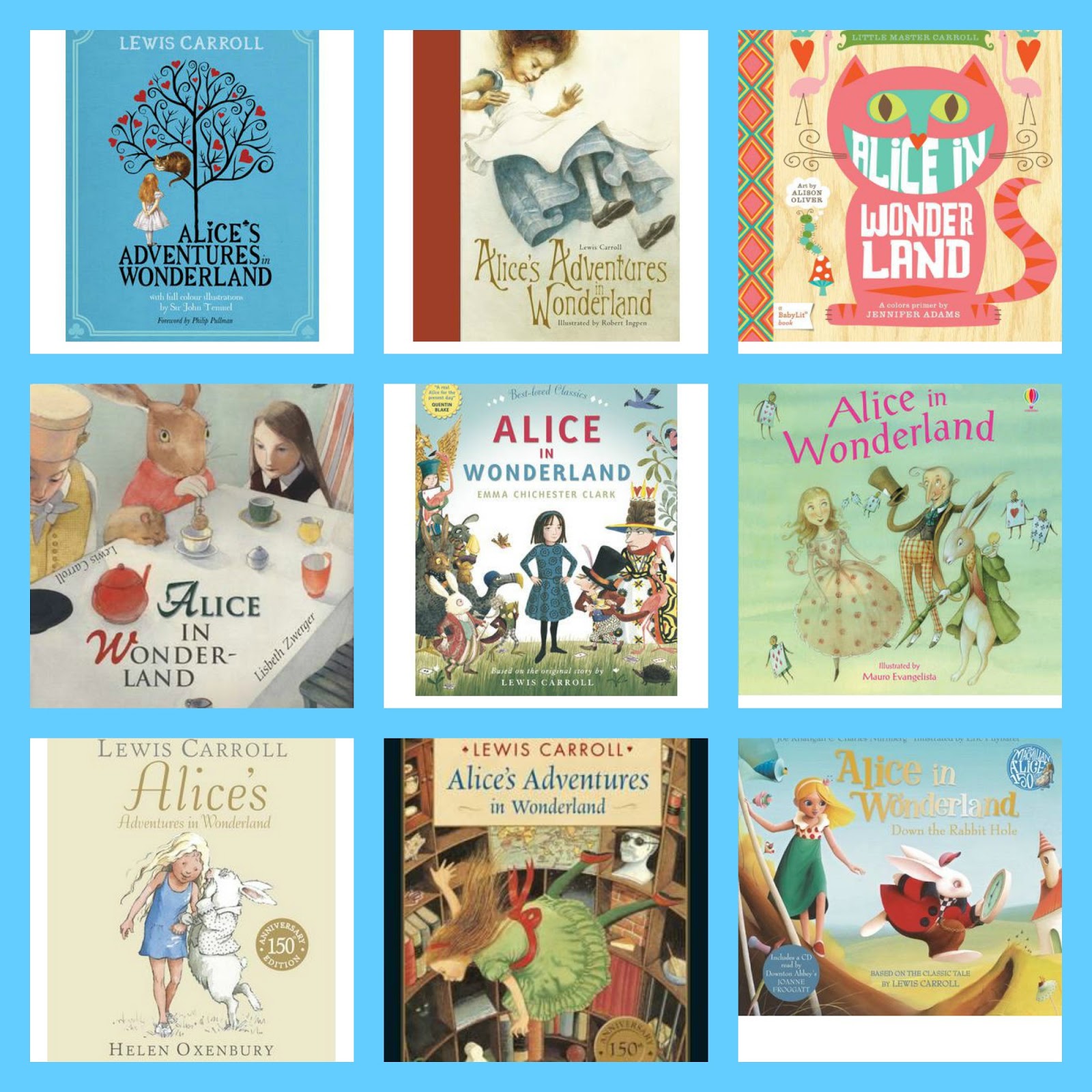
The fourth of July marks the anniversary of the day in 1862 when Charles Lutwidge Dodgson (Lewis Carroll)  and the Reverend Robinson Duckworth rowed in a boat up the Isis River with the three young daughters of Henry Liddell, the Vice-Chancellor of Oxford University. The middle daughter was ten year old Alice. During the journey Dodgson told the girls a story that featured a girl named Alice who goes looking for adventure. The next day he started writing the story down.  Several versions and trips later on 26th November, 1864 Dodgson gave a handwritten manuscript to Alice  as a Christmas present. Then in 1865 it was published as Alice's Adventures in Wonderland with illustrations by John Tenniel, so this year marks its 150 anniversary.

The story has become more popular with age as its fantasy world of peculiar anthropomorphic creatures, its structure and narrative course have undertaken much analysis and literary criticism and have thus its characters and imagery have influenced popular culture and literature. There are hundreds of versions available to children and adults. They range from preschool versions such as the board book by Jennifer Adams and Alison Oliver, through many of the abridged versions by publishers such as Usborne and Ladybird, picture book versions such as the one by Eric Puybaret,  beautifully illustrated versions by renowned illustrators such as Antony Browne, Emma Chichester Clark, Lizbeth Zwerger, Helen Oxenbury and Robert Ingpen right through to annotated versions such as Elucidating Alice for adults and spoofs such as Fifty Shades of Alice. It has inspired musicals, films, stage productions, sculptures, artworks and gardens.

I have collected all the versions in the library and put together a celebratory display.


Monday, March 30, 2015

30th March Take-a-Walk-in-the-Park Day

It is the last week of term before Easter holidays and it is frantic at school, so the thought of just walking out the door to the park for a little time out really does appeal at the moment. Perhaps I'll get to do it next week. I have several favourite park books, but am only going to mention a few.

1. Off to the Park!  by Stephen Cheetham because it is new, tactile and perfect for preschoolers.

2.  Not Like That, Like This!  by Tony Bradman because it always makes me smile when I read it with classes and see their reaction to what the father has done while visiting the park with his son.

3. A Walk in the Park  and Voices in the Park by Anthony Browne because they are perfect for discussions about point of view and how each participant can have been in the same place and yet have a very different story to tell.

So sometime in the holidays savour a walk in the park, breathe in the fresh air and take sometime time to reflect on the good things in life.


Monday, April 14, 2014

16th April World Voice Day


World Voice Day celebrates the importance of the human voice. Imagine having no voice. The only time I wish for that is on some wet days at school  when the class is stuck inside at lunchtime and are using outside voices. Getting the right voice for the right occasion can be so important. Every teacher has some management gimmick to ensure that her students know what is appropriate. Reading stories which promote discussion of the 'right' voice may also help. Here are some suggestions:

• Willow's Whispers by Lana Button and Tania Howells tells the story of a a shy and softly spoken girl called Willow and
how she resourcefully overcomes her school troubles.
Too Loud Lily by Sofie Laguna and Kerry Argent tells the story of Lily who is too loud at home and school, but she finally discovers she needs to be loud in the school play.
Loudmouth Louis by Anne Fine. This is a short novel suitable for serialising to young children. It is about Louis, a boy who never stops talking. He announces that he is going to be silent if people sponsor him in order to raise money for a new school library. Louis surprises himself, discovering that he actually likes listening to others.
My Mouth is a Volcano by Julia Cook. This too is about a boy named Louis who never stops talking. He interrupts all the time and says exactly what he is thinking.
Giraffe's Big Night by Carrie and David Grant. Giraffe is an opera singer about to embark on a performance. When she wakes that morning she finds that she is hoarse. How will she sing? This story shows children how precious and precarious a voice can be.

At school we often use the word 'voice' also in the context of writing. I love to use Voices in the Park by Anthony Browne to show students how the same events can appear to be very different when described by different witnesses. Here four characters all have the same experience in the park but you certainly get different points of view.


Saturday, August 10, 2013

9th August International Art Appreciation Day

Today is International Art Appreciation Day. When I was a child I knew nothing about art until high school. I didn't go to an art gallery till then either and there wasn't the abundance of beautifully illustrated picture books for children that there is today. I started my art education very late.


Luckily the children I teach have it very differently. They start their art education very young. In fact research shows that preschoolers are the ready foundation for art appreciation and that it should start then. Courses such as  Art Appreciation 101 for Young Children are flourishing and they teach that learning about art helps children improve their ability to observe things around them.  Using paintings, sculptures and pieces of architecture as prompts for thinking routines such as See Think Wonder help children to express creative ideas, communicate and develop language skills, use problem solving and reasoning skills.

If you don't use the Harvard Thinking routines it is as simple as asking children What do you see? What do you think of when you see this piece of art? How does it make you feel? What part of the story is this painting? Do you like it?

There are a myriad of ways to celebrate art that involves appreciation of it.
1. Visit a gallery or exhibition. I made a point of visiting my local gallery today. Last week I went to an exhibition put on by local printmakers.

2. Share picture books, especially those that feature the works of artists eg. Willy's Pictures by Anthony Browne,  Dan's Angel by Alexander Sturgis and Lauren Child or any of the Anholt's artists series by Laurence Anholt.

3. Look at books designed specifically for children which have large reproductions of famous paintings like those by Lucy Micklethwait. Her I Spy series also makes the art appreciation fun. Gillian Wolfe has a series that all have Look! in the title and similarly Gladys Blizzard has  a series Come Look With Me.

4. Look at books that go with a gallery and do things to draw you into a close study of their paintings. The Queensland Art Gallery does this in 21st Century Art for Kids.  Roy and Matilda: the Gallery Mice books by Susan Venn do this for the NSW Art Gallery, the Victorian Gallery and the Queensland Gallery. The National Gallery of Australia in Canberra has books it has published for themselves that introduce very young children to art that is in their gallery. Further afield the Metropolitan Museum of Art in New York  is an expert at this.

5. If you have never experienced a book published by Prestel for children you must. You will not be disappointed.


Tuesday, March 29, 2011

30th March Pencil Day


30th March marks the day when a patent was taken out by Hymen Lipman in 1858 on the first pencil with a rubber (eraser) attached and thus it has become known as Pencil Day.

Pencils, crayons, pens, all sorts of drawing implements feature in many books and usually they have a degree of magic where whatever they draw becomes reality. Anthony Browne realised the magic pencil's potential many years ago when he created the bear with the magic pencil. He appeared in Bear Hunt; Bear Goes to Town; Little Bear Book and A Bear-y Tale and when I began teaching these books created a lot of fun on rainy lunchtimes when my class would make their own bear and magic pencil adventures. Except for the first title these books seem to be out of print so you will need to hunt in a library. Recently Anthony Browne resurrected bear and turned the concept into a competition in Britain. The result of this is a new book called The Bear With the Magic Pencil. Maybe it will mean the older titles can be reissued.

Allan Ahlberg and Bruce Ingman also explore the concept of a pencil that can draw and create new objects in The Pencil. Everything goes well in this story until the pencil draws an eraser.
And, if you are looking for a longer book, but one that still has that sense of mischief, read Andy Griffiths' Pencil of Doom.

Of course the day could just be enjoyed by drawing with pencils, special pencils like aquarelles or metallic ones or by exploring how pencils are made. Angela Royston's book How is a Pencil Made? will help with this.


Friday, September 10, 2010

11th September Anthony Browne (1946)


Anthony Browne is an internationally acclaimed author/illustrator who won the prestigious Hans Christian Andersen Award for services to children's literature in 2000. He became the sixth British Children's Laureate in 2009 and in this role he says:


  • 'I hope to encourage more children to discover and love reading, but I want to focus particularly on the appreciation of picture books, and the reading of both pictures and words. Picture books are for everybody at any age, not books to be left behind as we grow older. The best ones leave a tantalising gap between the pictures and the words, a gap that is filled by the reader's imagination, adding so much to the excitement of reading a book.'


    His books have many fans as his protagonists seem to cry out for your empathy, possibly because they are sensitive souls who appear lonely even when surrounded by others. He has an affection for gorillas and they appear in many of his stories. The children in my library like his series of stories about Willy. See Willy the Wimp; Willy the Champ; Willy and Hugh and others. The parents like The Shape Game, Silly Billy and Piggybook. In his new book , Me and You, he has returned to fairytales for inspiration, here Goldilocks and the Three Bears, and like Hansel and Gretel it may appear to be dark, but as in many of his books he is looking at point of view, and here we get the bears and the intruding girl's point of view. Whichever of his books you choose to read there is always so much to look at, think about and admire.