Showing posts with label Emma Chichester Clark. Show all posts

Monday, December 9, 2024

14th December International Monkey Day

Monkeys, also known as simians, live all over the world. More than 260 species of monkeys populate Africa, Central America, South America, and Asia. They range in size from very small like the pygmy marmoset to the larger mandrill. Monkeys tend to walk on all four limbs. As a member of the primate family, they are considered a lesser ape. Most monkeys have a tail, though not all do. Monkeys are divided into two categories – Old World monkeys and New World monkeys. Old World monkeys live in Africa and Asia while New World monkeys live in South America.

Monkey species include baboons, macaques, marmosets, tamarins, and capuchins. Some of these monkeys have their own celebratory day.

It is International Baboon Day on 3rd December. It is International Macaque Day on 16th March. It is International Tamarin Day on 21st September, but I would find it very hard to celebrate these days in the library with books because we do not have that many books about specific monkeys.


I'd start this celebration of monkeys with a book such as Fourteen Monkeys  by Melissa Stewart and Steve Page so as to have the simians sorted.


Then some more non-fiction:


Next explore the myriad of fun 'monkey' stories.
See this Pinterest page for ideas.


Finish with Quentin Blake and Emma Chichester Clark's series about three little monkeys.


Thursday, July 2, 2015

4th July Alice Anniversary

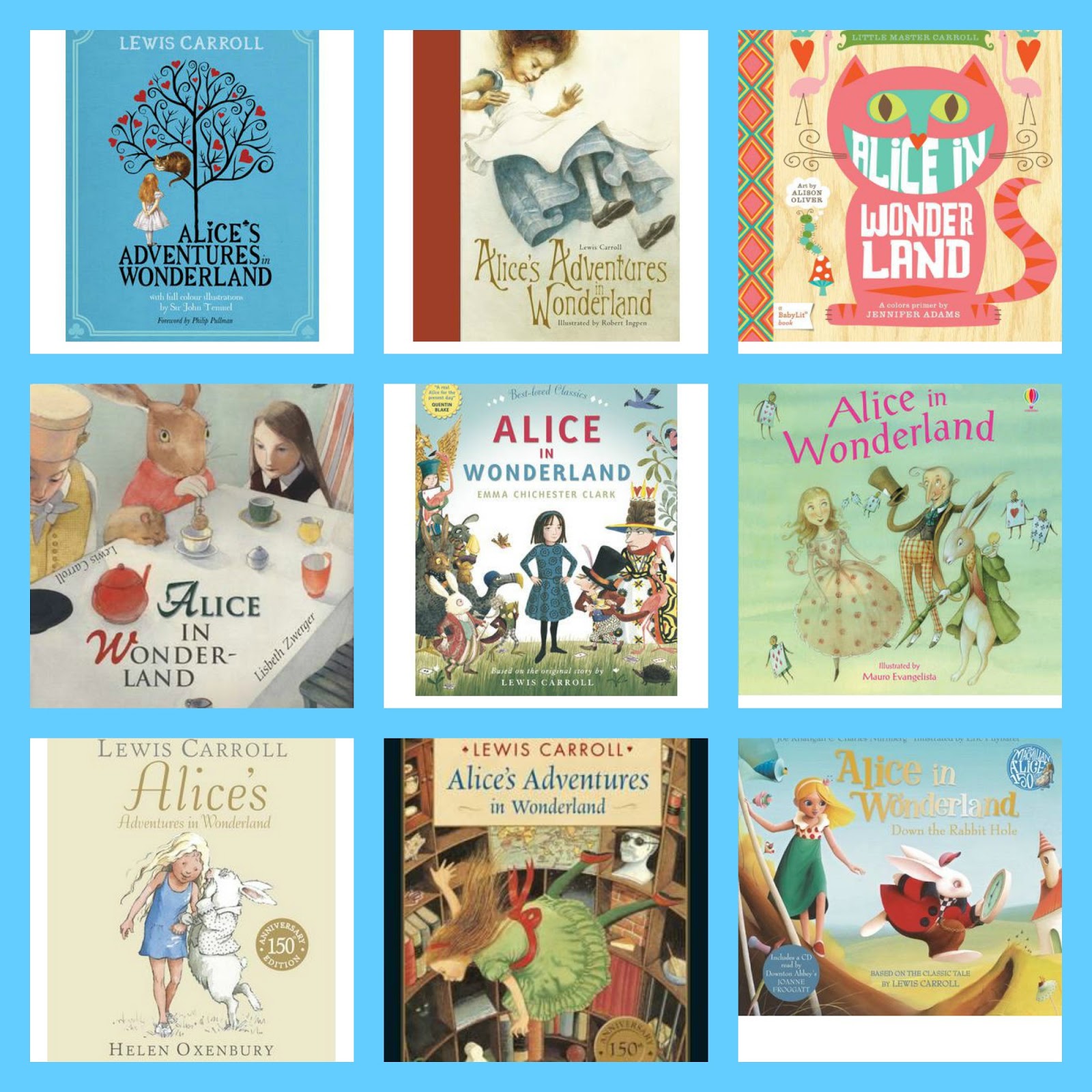
The fourth of July marks the anniversary of the day in 1862 when Charles Lutwidge Dodgson (Lewis Carroll)  and the Reverend Robinson Duckworth rowed in a boat up the Isis River with the three young daughters of Henry Liddell, the Vice-Chancellor of Oxford University. The middle daughter was ten year old Alice. During the journey Dodgson told the girls a story that featured a girl named Alice who goes looking for adventure. The next day he started writing the story down.  Several versions and trips later on 26th November, 1864 Dodgson gave a handwritten manuscript to Alice  as a Christmas present. Then in 1865 it was published as Alice's Adventures in Wonderland with illustrations by John Tenniel, so this year marks its 150 anniversary.

The story has become more popular with age as its fantasy world of peculiar anthropomorphic creatures, its structure and narrative course have undertaken much analysis and literary criticism and have thus its characters and imagery have influenced popular culture and literature. There are hundreds of versions available to children and adults. They range from preschool versions such as the board book by Jennifer Adams and Alison Oliver, through many of the abridged versions by publishers such as Usborne and Ladybird, picture book versions such as the one by Eric Puybaret,  beautifully illustrated versions by renowned illustrators such as Antony Browne, Emma Chichester Clark, Lizbeth Zwerger, Helen Oxenbury and Robert Ingpen right through to annotated versions such as Elucidating Alice for adults and spoofs such as Fifty Shades of Alice. It has inspired musicals, films, stage productions, sculptures, artworks and gardens.

I have collected all the versions in the library and put together a celebratory display.


Tuesday, October 14, 2014

15th October Emma Chichester Clark (1955)

Just when you think Emma Chichester Clark can't possibly do anything better than she has already done she does something new that has you just staring with awe and wondering how she can keep doing such beautiful books. Just last month there was the new picture book Bears Don't Read which reviews say is a "story of friendship to power the imagination and encourage children (and bears!) towards a lifelong love of reading."

And this month Plumdog, a book which has evolved from Emma's blog about her dog Plum. I love the way she writes and draws about Plum putting words in his mouth about herself and their relationship.

Last weekend I met a friend at the local bookshop where her children were spending birthday money. I was browsing as a I always do, saying in my head that I am not to buy anything for the school library. Well I didn't but I fell in love with a book, Classic Shakespeare Verse selected by Gina Pollinger and guess what it was illustrated by Emma Chichester Clark. What a find...a quote for every occasion, and another classic to add to my ECC collection, along with Grimm's, Hans Christian Andersen, Alice and Pinocchio.


Happy birthday Emma Chichester Clark. I love your work!

Tuesday, June 11, 2013

15th June The Power of a Smile Day

This week I have put together a small display highlighting how important it is to smile and the effect it can have because I wanted to celebrate Smile Power Day. I thought about doing this display after reading David Ezra Stein's book Because Amelia Smiled which tells about the pay forward concept that came about in New York when a small girl, Amelia smiled and this smile precipitated events all around the world. Walker Books says of it, 'David Ezra Stein's charmingly illustrated story reminds us that adding even a little kindness into the world is sure to spur more and more kindness, which could eventually make its way back to you!'

When I looked I found the library had all these other books about smiles too, among them:
Augustus and His Smile by Catherine Rayner
Smile! by Leigh Hodgkinson
It's Lovely When You Smile by Sam McBratney and Charles Fuge
Where's Your Smile, Crocodile? by Claire Freedman and Sean Julian
The Girl Who Lost Her Smile by Karim Alrawi and Stefan Czernecki
Melrose and Croc Find a Smile  by Emma Chichester Clark

And at school this morning when I got the books off the shelves to display I shared Taking a Bath with the Dog and Other Things that Make Me Happy by Scott Menchin and talked about what did make us smile. The opening words ...'I miss your smile today, Sweet Pea. What would make you happy?' asks the mother and then by the end Sweet Pea tells her  'I'm happy when I ...' and she lists off all the things that make her smile. I also read the afterword where Scott Menchin talks about his motives for writing the story and how he came to realise that 'what made me happy was doing what I enjoyed most.' Such a great book to get children thinking about the small things in life and how to make lists.

Remember to give everyone a big smile today as smiling can be contagious! Just watch this trailer and you'll see the power of picture books to make you smile.


Tuesday, October 12, 2010

15th October Barry Moser (1940) Emma Chichester Clark (1955)


Barry Moser is a much revered American artist who also illustrates children's books . I first met him through his books about his dog Rosie and granddaughter Isabelle. These three books ( My Dog Rosie; My Cats Nick and Nora and Our New Puppy) have simple text, but radiate with love for both the small girl, the dogs and cats. His more recent books, especially the three he has done for Margie Palatini's texts continue this perfection when drawing animals. I have written about Lousy Rotten Stinkin' Grapes (see 23rd June), we used The Three Silly Billies (a spoof which begins with the billy goats gruff but includes other fairytale characters) for a teacher's readers theatre performance during Book Week and Year 1 have fun with Earthquack! during their unit of inquiry that looks at under the ground.

Emma Chichester Clark is a British illustrator who also has a large list of publications, including anthologies, classics, fairytales and books for other authors, but she seems to have many titles for very young children which she has authored herself. She is responsible for three popular series, one about a small girl, Lily and her beloved Blue Kangaroo, another about Melrose, a dog and his friend Croc, a crocodile, and now a new one about Humber and Plum who are bear siblings. Her books are quickly recognizable, with bright colours and her trademark pink and blue.

Monday, February 22, 2010

24th February Wilhelm Grimm (1786 - 1859)

I much prefer the bleaker tales from the Grimm Brothers to the more romanticised versions from Perrault. I really like the Grimm version of Cinderella which doesn't have a fairy godmother, but instead has a hazel tree that she planted as a twig on her mother's grave. As Cinderella weeps on the grave, the tree grows. Not many of the Cinderella picture books use this version. There is only one version in my library and it is in tatters, out of print and thus irreplaceable. In the Grimm version the sisters mutilate their feet, in an attempt to fit their feet into the glass slipper. I don't need this grim detail as much, but the Grimm Brothers do need to be congratulated on their diligent collecting and recording of traditional tales, even if their intended audience wasn't children. Imagine a childhood without Rumplestiltskin, Rapunzel, The Twelve Dancing Princesses and Snow White and Rose Red.

A collection of ten of the Grimm fairytales that I like is The McElderry Book of Grimms' Fairy Tales retold by Saviour Pirotta and illustrated by Emma Chichester Clark. And, Michael Morpurgo's Hansel and Gretel also illustrated by Emma, is an amazing retelling of the traditional story with lots of added thematic depth for discussion.

It is often hard sharing fairytales with the children I teach because they are very quick to tell you that they know them, but when I delve a little, too often their way of knowing is through a Disney film or a television cartoon. Fairytales are an important source of rich book vocabulary. Where else will they read words such as 'gown', 'slipper', 'leagues', 'spindle', 'cobbler', 'thorns' and 'enchanted'? And, if they don't have a thorough introduction to fairytales how will they enjoy books such as The Sisters Grimm, spoofs such as those by Ann Jungman and Allan Ahlberg, the twisted tales of John Scieszka and the myriad of modern fairy tales?