Showing posts with label Gregory Rogers. Show all posts

Saturday, August 12, 2017

August Platypus Month

If you live in the Australian Capital Territory during August you can be on a platypus watch. How exciting. These animals are  special, but elusive, so to see one in its natural habitat would be so memorable. There is a good summary of what to know about platypuses here.

There is not an abundance of picture books about the platypus. Unlike echidnas, possums, wombats, kangaroos, bilbies and koalas who feature in stories and expository texts, platypus don't  and when they do they are often not written or illustrated by Australians.

Sue Whiting and Mark Jackson's  Platypus  is the most recent and the best. This book is part of the wonderful Nature Storybook series where there is two fonts, one telling a narrative and the other giving facts about the animal.  These other three are older, but they will add to your knowledge and allow the reader to see the platypus as a story character and learn some of the Aboriginal Dreamtime connection it has and they are published in Australia.

• Little Platypus by Nette Hilton and Nina Rycroft
• The Platypus What is it? by Jo Brice and Gregory Rogers
• The Little Platypus and the Fire Spirit by Mundara Koran


Saturday, August 3, 2013

5th - 11th August Homeless Person's Week


Homeless Persons' Week (HPW) is an annual themed week coordinated by Homelessness Australia.  It is used to raise awareness of people experiencing homelessness and the surrounding issues. It is held in the first full week of August each year. And while it is not a topic I would usually embrace explicitly with the young children I teach there are books that I might read to and discuss with them that highlight how important it is to have a home. While talking I might also touch upon how important it is to have a private place, a space that you can call your own, and how for many people, children included this is difficult because of the home they live in. It may be overcrowded, under-resourced, lacking in adult supervision or just too temporary.

These books do some of these things:
• Way Home  by Libby Hathorn and Gregory Rogers. This classic prize-winner was published after Margaret Wild and Gregory Rogers' Space Travellers which also dealt with homelessness, but this time the 'aura' of the book was much more convincing. A young boy Shane appears to be wandering the city streets at night. He finds a cat and takes it home with him. Home, as you find out at the end of the story is a makeshift cubbyhole. The tenderness Shane shows to the cat highlights what being 'human' is about and gives the reader hope. The illustrations are rich visually and choosing one of the double page spreads would make a good stimulus for a See Think Wonder routine or the Making Thinking Visible routine that looks at what comes before and after this picture.

• Flyaway Home  by Eve Bunting and Ronald Himler tells the story of a young boy and his father who live in an airport and have to keep moving from terminal to terminal to avoid being noticed. The boy observes a trapped bird who finally finds freedom and this gives the boy hope for the future. So just like Shane who reaches out to the cat, this boy empathises with the bird.

• Broken Beaks  by Nathaniel Lachenmeyer and Robert Ingpen. This is the story of friendship between a sparrow and a homeless man who suffers from a mental illness. It uses the metaphor of broken beaks to explain disabilities.
It is interesting that like the two stories above that need for love and being with other living things is also highlighted through friendship with an animal.

--Dr. Jane Goodall, DBE; Founder the Jane Goodall Institute; UN Messenger of Peace
"Enchanting, moving, and beautifully written. Broken Beaks is a brilliant way to help young children begin to understand the tragedy of the homeless."


• Four Feet, Two Sandals by Karen Lynn Williams, Khadra Mohammed and Doug Chayka. This story is set in a refugee camp in Pakistan where families are waiting to be resettled. When some clothing is delivered two young girls find one sandal each and would like to find its partner. In the process Lina and Feroza meet and begin to understand the meaning of sacrifice and friendship. 

• One Hen by Katie Smith Milway and Eugenie Fernandes. In this story of a young Ghanian boy, named Kojo, he is not homeless, but extremely poor. With a small loan he buys a chicken and then sells his eggs and thus becomes able to sustain himself and eventually others. This inspiring story shows children what can happen with hard work, the desire to change and help given for the right things. It is also based on a true story and the real-life story of Kojo is at the back of the book.

•Scrawny Cat by Phyllis Root and Alison Friend. This story is much more lightweight than the others, but very suitable for a discussion about home and being homeless with very young children. Here a lost, scrawny, and hungry cat finds himself alone in the world after having once been loved by someone who scratched behind his ears and used his name. Now he is lonely and everyone just tells him to 'get out of here'. Finally he finds someone who takes him in.


Sunday, June 16, 2013

19th June Gregory Rogers (1957 - 2013)

Australian illustrator Gregory Rogers would have celebrated his birthday on the 19th June, but sadly he died on the 1st May, long before he should have. He was the first Australian to win the prestigious Kate Greenaway Medal. He won in 1995 for Libby Hathorn's Way Home, a controversial and very different picture book at the time, about a homeless boy and where he called 'home'.

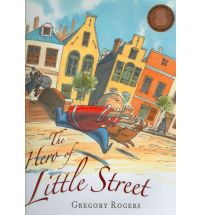
Greg then went on to produce his wonderful wordless series of three books, the last The 
Hero of Little   Street, winning the Australian Picture Book of the Year in 2010 among other awards.


I was pleased to see a new book today at the bookshop, What's Wrong With the Wobbegong?  written by Phillip Gwynne and illustrated by Gregory Rogers. I thought the illustrations were funny and was pleased to see that this review agreed with me. Wobbegong sharks, so Australian, black humour and a pertinent message...what more could we want?

Saturday, August 21, 2010

22nd August Children's Book Week


It is Children's Book Week in Australia! Time to celebrate Australian books and all they have to offer children. At school I have been having fun sharing the shortlisted Picture Books and Early Childhood books with classes. We have discussed them, voted for ourselves and argued about why one is better than another. Of course, although we did have voting criteria, it seems inevitable that the children nearly always seem to choose different titles from the adult judges. I think that their main criteria this year was 'humour' as the most popular titles were Bear and Chook By the Sea; The Terrible Plop and Mr Chicken Goes to Paris.

Bear and Chook by the Sea was the winner in the Early Childhood category so the children will be pleased tomorrow when I tell them. Lisa Shanahan and Emma Quay's first book about the unusual twosome of Bear and Chook, Bear and Chook was also popular when it was published so we revisited it too. The children love that the characters are so different in every respect, yet are such good friends. They drew comparisons between them and Minton and Turtle in the Minton books where one character is also adventurous and the other extremely wary and negative. I love it when young children make connections such as this. They also noticed how the characters reversed roles later in the story, both in this book and with the rabbit and bear in Ursula Dubosarsky's The Terrible Plop.

Dubosarsky's rollicking rhyme and rhythm in The Terrible Plop together with Andrew Joyner's illustration's fluid lines give this story a pace and drama that sustains children's interest, intrigue and surprise right to the fitting end where the rabbit is almost heroic. The children will also be pleased to hear that this book won The Crichton Award for new illustration for Andrew Joyner and hopefully this means we will get to see more picture books with his name on the cover.

The Hero of Little Street by Gregory Rogers won the Picture Book of the Year. This is a beautiful book also with an exciting, fast moving story, but it is textless and therefore very difficult to share en masse with a class. It needs concentrated attention, many readings and time to savour its cleverness. It definitely deserved to win. It is the third book in a series of books about a boy which began with The Boy, the Bear, the Baron, the Bard.

In contrast Mr Chicken Goes to Paris seems lightweight, but in a school where French is the language taught in Early Childhood classes and Leigh Hobbs is a favourite because of Old Tom and Horrible Harriet, it is not surprising that humour won out when the children voted. I love Narelle Oliver's books and last term we looked at foxes in children's books and character stereotypes, so Fox and Fine Feathers was voted in second place, possibly by those eager to please me!