Showing posts with label Libby Hathorn. Show all posts

Thursday, June 29, 2023

Read Grow Inspire Book Week Slogan 2023 (Part 5) INSPIRE

 INSPIRE     WHO?


Inspire the World: A Kid's Journey to Making a Difference by Sammie Vance and Talitha Shipman

Obviously not every child is going to be a Sammie Vance. Sammie felt inspired to talk to her school principal about her plan for a friendship bench at her school, but what started as 8-year-old Sammie Vance's mission to get a buddy bench for her school to fight loneliness grew to be so much more. Now Sammie is making a difference beyond her hometown. In her first-ever book, Sammie shares how she's inspiring others through recycling, community, giving, determination, bravery, helping, being herself, and celebrating. She wants to inspire the world one kid at a time. Her website will tell you more. But, the good thing about introducing your students to Sammie Vance is that it shows them that a child can make a difference.

There are plenty of books you could use to inspire children or where they can see what has inspired people to do things. Our school has made a concerted effort to encourage Voice and Agency in our students. This too can be initiated by reading. Schools read about worm farms and get one, read about native bees and get a hive for their playground, read about the perils of plastic and change their lunch eating habits!

Below are some books which I think make good starting points for inspiration:

Grow  by Cynthia Platt and Olivia Holden Looking at a drab abandoned city lot, a girl has an idea. As she begins pulling weeds, neighbours young and old, black, brown, and white come to help. The community joins together, creating a colorful garden for all to enjoy. It is possible for one child to make a difference? Or

The Secret Sky Garden by Linda Sarah and Fiona Lumbers where Funni loves the old, disused car park, and spends a lot of time there flying her kite and playing her recorder, but something is missing. Definitely. So Funni decides to create a garden in the neglected space and after weeks of careful nurture, her garden in the sky takes shape.

The Wild Garden  by Cynthia Cliff

This book takes a look at the community garden as well as the environment beyond the community garden. Its message is about not expanding the planned community garden because it will take away the needed wild plants that the wildlife needs. We need to stop taking away from nature and learn to live with nature.  When the town wants to expand the garden Jilly and her grandfather show the people what the expansion will do and inspire them to wonder more broadly about the nature around them. Imagine if everyone learned to live with the nature as it is and help the wildlife instead of taking their space and needed ecosystems?


You Are a Beautiful Beginning by Nina Laden and Kelsey Garrity-Riley

Three children come together to build a magnificent and cozy treehouse for all their forest friends. Along the way, they discover the truth behind the adage that 'it is not the destination, but the journey.' his meditative and magical picture book encourages readers old and young to discover their own endless potential. This meditative and magical picture book encourages readers to discover their own endless potential. 


Wild Ideas  by Elin Kelsey and Soyeon Kim

Wild Ideas looks deep into the forests, skies and oceans to explore how animals solve problems. Whether it's weaving a safe place to rest and reflect, blowing a fine net of bubbles to trap fish, or leaping boldly into a new situation, the animals featured teach us a lot about creative problem solving tools and strategies. It  invites readers to indulge their sense of wonder and curiosity by observing the natural world, engaging with big ideas and asking questions.


We Move the World  by Kari Lavelle and Nadi H. Ali. Meet some of the world’s most beloved movers, shakers, scientists, activists, dreamers, and doers from the past and present who model what every childhood first can lead to! Neil Armstrong, Misty Copeland, Ruth Bader Ginsburg, and more were once kids they grew up to lead us to the moon, dance in the ballet, and break barriers. From first steps to solving puzzles and learning the alphabet, all the small things are only the beginning: they can lead to future activism and innovation that just might change the world!  Or

Children Who Changed the World  by Marcia Williams which tells the incredible true stories of child activists such as Baruani Ndume, the teenager who gave a voice to fellow refugee children in Tanzania.

In Our Hands by Lucy Farfort

When the world is plagued with isolation and cursed to live without colour, it is up to a group of determined children to grow a seed of hope that will inspire everyone to come together and build a better future. 


I Am One: A Book of Action by Susan Verde and Peter H. Reynolds

On the first page, the main character asks a beautiful bird, "How do I make a difference?" They doubt their ability to make a difference because they are "so small." However, when the bird gives them a seed, they realize that "beautiful things start with just One." They can plant a seed and start a garden They can also start a journey, paint a masterpiece, compose a melody, and break down walls. All these actions start with "one" thing: a first step, a first stroke of paint, a first musical note, and a first brick. 


Now, I hear you saying it's for Book Week and none of these books are Australian, so here's a favourite of mine (I have a framed print of the cover illustration courtesy of my friend at Momotimetoread who knows how besotted I am about plants and trees).

Florette by Anna Walker 

Mae’s family moves to a new home in the city.  Mae wishes she could bring the garden with her. She’ll miss the apple trees, the daffodils and the butterflies in the long, wavy grass, but there’s no room for a garden in the middle of the city ...Or is there? What she finds there sparks something special and beautiful that will make her feel much more at home.


If you are lucky enough to have a copy of Bob Graham's new book The Concrete Garden by the time Book Week comes around you could read it as it promises to be a timely, inspiring and uplifting story about hope and the power of creative expression.

When the children leave their homes,  Amanda is the last one out of the tower block. She brings some chalk with her. On every inch of the concrete outside, the children draw pictures of everything they could think of, from flowers and snails, to spaceships and queens. Before long, a beautiful and exotic garden is spread out across the concrete. You could compare this to The Chalk Garden by Sally Anne Garland where Emma uses her imagination to draw a beautiful flower garden with sidewalk chalk.  A tiny ecosystem develops outside her door, with real-life flowers that bud and bloom!


And lastly, I have just purchased Mother Earth: Poems to Celebrate the Wonder of Nature by Libby Hathorn and Christina Booth. The poems are good and you will enjoy reading them but the front endpapers are the piece de resistance. Here Christina Booth has painted a sublime illustration of nodes and tendrils pushing up through the dirt towards the sky surrounding a haiku, called Earth. There are teaching notes for this book here.


Saturday, August 3, 2013

5th - 11th August Homeless Person's Week


Homeless Persons' Week (HPW) is an annual themed week coordinated by Homelessness Australia.  It is used to raise awareness of people experiencing homelessness and the surrounding issues. It is held in the first full week of August each year. And while it is not a topic I would usually embrace explicitly with the young children I teach there are books that I might read to and discuss with them that highlight how important it is to have a home. While talking I might also touch upon how important it is to have a private place, a space that you can call your own, and how for many people, children included this is difficult because of the home they live in. It may be overcrowded, under-resourced, lacking in adult supervision or just too temporary.

These books do some of these things:
Way Home  by Libby Hathorn and Gregory Rogers. This classic prize-winner was published after Margaret Wild and Gregory Rogers' Space Travellers which also dealt with homelessness, but this time the 'aura' of the book was much more convincing. A young boy Shane appears to be wandering the city streets at night. He finds a cat and takes it home with him. Home, as you find out at the end of the story is a makeshift cubbyhole. The tenderness Shane shows to the cat highlights what being 'human' is about and gives the reader hope. The illustrations are rich visually and choosing one of the double page spreads would make a good stimulus for a See Think Wonder routine or the Making Thinking Visible routine that looks at what comes before and after this picture.

Flyaway Home  by Eve Bunting and Ronald Himler tells the story of a young boy and his father who live in an airport and have to keep moving from terminal to terminal to avoid being noticed. The boy observes a trapped bird who finally finds freedom and this gives the boy hope for the future. So just like Shane who reaches out to the cat, this boy empathises with the bird.

Broken Beaks  by Nathaniel Lachenmeyer and Robert Ingpen. This is the story of friendship between a sparrow and a homeless man who suffers from a mental illness. It uses the metaphor of broken beaks to explain disabilities.
It is interesting that like the two stories above that need for love and being with other living things is also highlighted through friendship with an animal.

--Dr. Jane Goodall, DBE; Founder the Jane Goodall Institute; UN Messenger of Peace
"Enchanting, moving, and beautifully written. Broken Beaks is a brilliant way to help young children begin to understand the tragedy of the homeless."


Four Feet, Two Sandals by Karen Lynn Williams, Khadra Mohammed and Doug Chayka. This story is set in a refugee camp in Pakistan where families are waiting to be resettled. When some clothing is delivered two young girls find one sandal each and would like to find its partner. In the process Lina and Feroza meet and begin to understand the meaning of sacrifice and friendship. 

One Hen by Katie Smith Milway and Eugenie Fernandes. In this story of a young Ghanian boy, named Kojo, he is not homeless, but extremely poor. With a small loan he buys a chicken and then sells his eggs and thus becomes able to sustain himself and eventually others. This inspiring story shows children what can happen with hard work, the desire to change and help given for the right things. It is also based on a true story and the real-life story of Kojo is at the back of the book.

Scrawny Cat by Phyllis Root and Alison Friend. This story is much more lightweight than the others, but very suitable for a discussion about home and being homeless with very young children. Here a lost, scrawny, and hungry cat finds himself alone in the world after having once been loved by someone who scratched behind his ears and used his name. Now he is lonely and everyone just tells him to 'get out of here'. Finally he finds someone who takes him in.


Sunday, June 16, 2013

19th June Gregory Rogers (1957 - 2013)

Australian illustrator Gregory Rogers would have celebrated his birthday on the 19th June, but sadly he died on the 1st May, long before he should have. He was the first Australian to win the prestigious Kate Greenaway Medal. He won in 1995 for Libby Hathorn's Way Home, a controversial and very different picture book at the time, about a homeless boy and where he called 'home'.

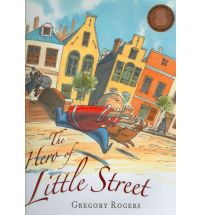
Greg then went on to produce his wonderful wordless series of three books, the last The 
Hero of Little   Street, winning the Australian Picture Book of the Year in 2010 among other awards.


I was pleased to see a new book today at the bookshop, What's Wrong With the Wobbegong?  written by Phillip Gwynne and illustrated by Gregory Rogers. I thought the illustrations were funny and was pleased to see that this review agreed with me. Wobbegong sharks, so Australian, black humour and a pertinent message...what more could we want?

Friday, September 24, 2010

26th September T.S.Eliot (1888 - 1965) Libby Hathorn (1943) Rob Scotton (1960) Mark Haddon (1962)


With so many birthdays, this will be one of those a-little-bit -about-each-with-no-meat entries. For children T.S Eliot is probably best known for his poem Macavity - The Mystery Cat which I could recite movingly by mid-primary school. I think I even recited it at an eisteddfod one year. This poem comes from Eliot's book Old Pussum's Book of Practical Cats, a new edition of which was published last year. It is a beautiful book with illustrations by Axel Scheffler (of Gruffalo fame) which make it even more appropriate for young children.

Libby Hathorn is an Australian author who writes novels and picture books. I especially like her novels, but for my clientele her picture books are more relevant and recently I discovered one I hadn't read, Zahara's Rose. This wordy picture book (complete with six chapters) is set in the Middle East and the Hanging Gardens of Babylon. It has the feel of an exotic fairy tale with the added bonus of garden images. To learn more about Libby and her books see her website.

Rob Scotton is the English author/illustrator responsible for those irreverent characters Splat the Cat and Russell the Sheep, both of which now have a series of books about them. Rob's recent Splat title Scaredy-Cat, Splat has arrived just in time for Halloween. I had a giggle at the page where Splat's cat friends, Spike and Plank are dressed as a mummy and a skeleton. Splat is a sock spider. That's the sort of dress-up idea my mother would have had!

And lastly, Mark Haddon, famous for The Curious Incident of the Dog in the Night-Time is an English author who writes novels, but has several picture books that we have in the library.
See Ocean Star Express; The Ice Bear's Cave and The Sea of Tranquility. The last of these is beautifully illustrated by Christian Birmingham and it is about the first moon landing.