Showing posts with label astronomy. Show all posts

Saturday, February 14, 2026

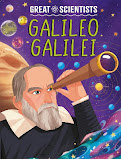
15th February Galileo Day


15th February each year is Galileo Day - a celebration of the anniversary of Italian Galileo Galilei's birth in 1564. He died on 8th January 1642.
 He was a physicist, a mathematician, an astronomer and a philosopher. Galileo was best known for his work supporting Copernicanism, showing the Earth was in fact not at the centre of the universe. He was the scientist who first saw the craters of the Moon, the moons of Jupiter, and the phases of Venus. His discoveries shook the world and proved that the planets orbit the Sun!


Galileo was a truly inspirational scientist. Like Darwin, the ideas he put forward, though correct, were met with large amounts of controversy and resistance from the Church. However, he stuck to the scientific method and followed the conclusions the evidence led to. He built on what Nicolaus Copernicus (born 19th February, 1473) believed and went on to prove him correct. It will be Copernicus Day on the 19th February. 

The library has many books about astronomy, but these are about Galileo in particular:


Monday, July 28, 2025

1st August Women Astronomers Day

Women Astronomers Day is a celebration dedicated to the trailblazing women who have expanded our understanding of the universe. This day sheds light on the many discoveries made by female astronomers and more so the achievements of Maria Mitchell whose birthday was on this day.

“I live and work with three basic assumptions: 1) There is no problem in science that can be solved by a man that cannot be solved by a woman. 2) Worldwide, half of all brains are in women. 3) We all need permission to do science, but, for reasons that are deeply ingrained in history, this permission is more often given to men than to women.” Vera Rubin

Before 1900, a woman who wanted to study the stars had to have a father, brother, or husband to provide entry, and even then the considerable intellectual skills of women astronomers were still not enough to enable them to pry open doors of opportunity for much of the twentieth century. After decades of difficult struggles, women are closer to equality in astronomy than ever before.

The good thing for us, is that we can read about these famous women in picture book biographies and be inspired by not only their hardships but also their achievements.

Caroline Herschel (1750 -1848) was most likely the first female astronomer that we should read about. She was a German astronomer, whose most significant contributions to astronomy were the discoveries of several comets. She was the younger sister of astronomer William Herschel, with whom she worked throughout her career.

Caroline's Comets  by Emily Arnold McCully

Comet Chaser  by Pamela Turner


Maria Mitchell (1818 -1889) was the first internationally known woman to work as both a professional astronomer and a professor of astronomy.

Maria's Comet  by Deborah Hopkinson

What Miss Michell Saw by Hayley Barnett

Her Eyes on the Stars  by Laurie Hallmark

The Astronomer Who Questioned Everything  by Laura Alary


Willamina Fleming (1857 - 1911) was a pioneering Scottish  astronomer. She was hired by the director of the Harvard College Observatory to help in the photographic classification of the stellar spectrum. She helped develop a common designation system for stars and catalogued more than ten thousand stars.

She Caught the Light  by Kathryn Lasky 


Annie Jump Cannon ( 1863 - 1941) was known as the “census taker of the sky.” She was a brilliant astronomer that revolutionised the way scientists classify stars. 


Henrietta Leavitt (1868 - 1921) was an American astronomer. Her discovery of how to effectively measure vast astronomical distances led to a shift in the understanding of the scale and nature of the universe.

Look Up by Robert Burleigh


Cecilia Payne (1900 - 1979) was a British-born American astronomer and astrophysicist. Her work on the cosmic makeup of the universe and the nature of variable stars was foundational to modern astrophysics. She determined that stars were composed primarily of hydrogen and helium in her 1925 doctoral thesis.

The Fire of the Stars by Kirsten W. Larson


Nancy Grace Roman (1925 - 2018) was an American astronomer,  the  first female executive at NASA, and served as NASA's first Chief of Astronomy throughout the 1960s and 1970s.

Always Looking Up by Laura Gehl


Vera Rubin (1928 - 2016) was an American astronomer who pioneered work on galaxy rotation rates, and confirmed the existence of dark matter, forever changing the field of astronomy and our understanding of the universe. 

The Stuff Between the Stars  by Sandra Nickel

Shining Star Vera Rubin Discovers Dark Matter  by Suzanne Glade


Jocelyn Bell Burnell (1943 - ) 
is a Northern Irish physicist who, while conducting research for her doctorate, discovered the first radio pulsars  in 1967.

 Listening to the Stars by Jodie Parachini


Gabriela Gonzalez (1965 - ) is an Argentine professor of physics and astronomy who works in the USA.. Completing the work that Albert Einstein had begun 100 years earlier, Gonzalez broke ground for new space-time research.

How to Hear the Universe  by Patricia Valdez


These two astronomers don't have a book of their own yet!

Andrea Ghez (1965 -) is a professor of physics and astronomy at UCLA. She shared  the 2020 Nobel Prize in physics for finding a supermassive black hole stuffed with 4 million suns at the centre of our galaxy. Among the four female Nobel Laureates in physics to date, Ghez is the only astronomer.

Sara Seager (1971 -) is  a Canadian-American astronomer and planetary scientist. She has two main goals: the discovery of another Earth and the search for signs of life beyond Earth. 

Australia has 5 top women astronomers who hopefully will have a picture book biography about them someday.

Tuesday, February 11, 2025

15th February Galileo Day


One of the most important figures to come out of the awakening world of the Renaissance was Galileo Galelei. Galileo was forever asking questions. Is it possible to measure heat? Can you weigh air? Does the earth stand still or does it move? How fast do objects fall to the earth? These questions, and his answers to them, led to some of the most important discoveries ever in astronomy, physics, mathematics, and the natural world.

Among his many accomplishments Galileo advanced the astronomical telescope and invented the compound microscope. He measured the rotation of the sun, invented the thermometer, a geometrical compass, and the pendulum clock.

Albert Einstein called Galileo “the father of modern science.” 

When my daughter was at school she was fascinated by Galileo and how he proved that the sun was at the centre of the solar system. She was fascinated that people once thought the earth was flat and that you could walk off the edge. She was very happy to read whatever she could about Galileo so I brought books home from the school library.

Galileo for Kids by Richard Panchyk
This book will inspire kids to be stargazers and future astronauts or scientists as they discover Galileo's life and work. Activities allow children to try some of his theories on their own, with experiments that include playing with gravity and motion, making a pendulum, observing the moon, and painting with light and shadow. Along with the scientific aspects of Galileo's life, his passion for music and art are discussed and exemplified by period engravings, maps, and prints. 


I, Galileo  by Bonnie Christiansen
Bonnie Christensen adopts the voice of Galileo and lets him tell his own tale in this outstanding picture book biography. The first person narration gives this book a friendly, personal feel that makes Galileo’s remarkable achievements and ideas completely accessible to young readers. 


Galileo's Leaning Tower Experiment  by Wendy Mcdonald and Paolo Rui
When the great scientist and professor Galileo meets a bright farm boy, Massimo, the teacher becomes the student. On an ordinary day, Galileo encounters Massimo dropping food from a bridge to his uncle passing below in his boat.


Starry Messenger  by Peter Sis 
In every age there are courageous people who break with tradition to explore new ideas and challenge accepted truths. Galileo Galilei was just such a man--a genius--and the first to turn the telescope to the skies to map the heavens. In doing so, he offered objective evidence that the earth was not the fixed center of the universe but that it and all the other planets revolved around the sun. Galileo kept careful notes and made beautiful drawings of all that he observed. Through his telescope he brought the starts down to earth for everyone to see. 


And some more recent books about Galileo and his discoveries:

Galileo Galilei (2023) by Jane Kent and Isabel Munoz
Meet Galileo Galilei and discover the story of his life and work in this engagingly illustrated biography - narrated by the scientist himself. Astronomer, physicist, and philosopher Galileo Galilei was referred to as "The Father of Modern Science," because of his groundbreaking research. Making observations about nature, and using mathematics to back them up, he proved the Copernican Theory true: the Sun, not the Earth, is the centre of the universe.


Galileo Galilei (2024) by Alexandra Badiu and Anna Baker 
Tells the story of 'the father of science' - covering his origins as the son of a musician through his work in astronomy and optics, his troubles with the Church and his enduring legacy today.


Saturday, November 9, 2024

10th November Carl Sagan Day

November 10th is Carl Sagan Day, marking the birthday of this incredible American astronomer, scientist, and author best known for his research on extraterrestrial life.

When Carl Sagan was a young boy he went to the 1939 World's Fair and his life was changed forever. From that day on he never stopped marveling at the universe and seeking to understand it better. Star Stuff follows Carl from his days star gazing from the bedroom window of his Brooklyn apartment, through his love of speculative science fiction novels, to his work as an internationally renowned scientist who worked on the Voyager missions exploring the farthest reaches of space. This book introduces the beloved man who brought the mystery of the cosmos into homes across America to a new generation of dreamers and star gazers.


Thursday, May 16, 2024

18th May International Astronomy Day


International Astronomy Day is a holiday that is celebrated not once during a calendar year but twice a year – once in spring and once in autumn.
 The purpose of this holiday is not only to celebrate astronomy and all of its contributions to society but also to bring the general public together with astronomy professionals and groups.

Astronomy goes all the way back to antiquity and is in fact, one of the oldest natural sciences in the world.

Of course you can just go outside and look up at the sky, but to know what you are looking at, you may need to look in a few books first.

Do you have a telescope? What can you do with a telescope? What will you see?

These books will help answer these questions.


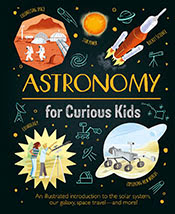
Some books that will help with knowing what you're looking at:


This is a new Australian book from the CSIRO and a book by Australian astronomer Lisa Harvey-Smith.


Then if you know a child who is astronomy-mad and sees their future being a contributor to that world, explore some of the wonderful picture book biographies about famous space devotees.