Showing posts with label water. Show all posts

Sunday, August 24, 2025

27th August World Lake Day


 World Lake Day is an observance celebrated by the United  Nations to raise awareness of the importance of lakes and their ecosystems. Lakes are one of the most vital natural resources on our planet.They serve as a crucial source of fresh water, supporting drinking water supplies, agriculture, and industry.

Lakes also play a key role in maintaining biodiversity, offering a habitat for countless species of fish, plants, and wildlife.

Beyond their ecological significance, lakes contribute to climate regulation by keeping the planet cool, absorbing the floodwater and storing carbon.

Additionally, they provide recreational and economic opportunities, attracting tourism, fishing, and other activities that support local communities.

But, lakes are affected by a combination of overuse, pollution and climate change.

Did you know? Natural and artificial lakes contain more than 90% of the fresh water on the surface of the Earth.

What is a lake? A lake is a body of water, typically fresh water, that is surrounded by land.  Lakes are generally larger and deeper than ponds, and they are a vital part of the Earth's water cycle. Lakes can be natural formations, or they can be man-made, such as reservoirs. 

So is a pond a lake? From a regulatory viewpoint, there is no distinction between a lake and a pond. Both are surface waters. From a naming convention, there is no precise difference between a lake and pond, although waterbodies named 'lakes' are generally larger and/or deeper than waterbodies named 'ponds'.


Canada has the most lakes, holding roughly 62% of the world's lakes. 
Australia has fewer naturally formed freshwater lakes compared to continents with more glacial activity and tectonic uplift. However, it does have some, including coastal lagoons and lakes in ancient volcanic craters like lake Gambier and Lake Eacham.  It also has vast salt lakes like Lake Eyre which is often dry and glacial lakes like Lake St Clair in Tasmania.

There are so many books featuring lakes and ponds that you certainly won't have any trouble finding some for a display. You could even add your books about Swan Lake to get the students wondering.


Sunday, July 20, 2025

29th July World Rain Day


Throughout human history, people and cultures around the world have celebrated rain and its life-giving power. All life depends on rain and rain keeps our world green and fresh. Rain Day celebrates all that is wet and beautiful.

Rainfall is the main way water gets to the ground, providing drinking water for animals and plants, replenishing groundwater, and filling our rivers and lakes. When you think about it from this perspective, you understand why rain is critical for our lives and why it should be appreciated and celebrated.
In the library it is very easy to celebrate. I put 'rain' in the title search of the catalogue and we have over 100 books without looking at books about weather, mud, hail, monsoons or any other things related to rain or water. That's enough books for a display! Some of them are beautiful and not borrowed that often.
Of course in Australia, how you feel about rain depends a lot upon where you live as droughts and floods seem to be occurring somewhere constantly.
The books below are some of the books that have 'rain' in their title. Often I put a question with a display to make the children think. It could be simple like 'What do all these books have in common?' or 'How do you feel about rain? Which book on display do you think will match your feelings about rain?'


Thursday, March 20, 2025

22nd March World Rights to Water Day


Sustainable Development Goal 6 declares the importance of achieving "clean water and sanitation for all".


World Rights to Water Day advocates for access to water as a human right as without water, decent life isn't possible. we take it for granted that when we turn on a tap clean water will pour out, but we forget that  1 in 3 people don't have access to  clean drinking water. Even the water we have is a precious resource that is under threat due to the growing population, unsustainable agriculture practices, overuse of chemicals and  climate change.

I have written about water at length elsewhere in this blog, just search using the word 'water', but today I just wanted to focus on books that shock my students into thinking about water. They are always amazed to see that children as young as them need to carry water back to their home.

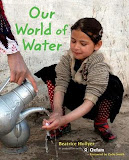
Our World of Water  by Beatrice Hollyer

Wherever we live in the world - whether our country is rich or poor - water is vital to our survival on this planet. This book follows the daily lives of six children from Peru, Mauritania, Bangladesh, Ethiopia, Tajikistan and California and explores what water means to them. Where does it come from? How do they use it?


Fatou Fetch the Water
 by Neil Griffiths

Set in Gambia The water bucket is empty! So, follow in the footsteps of forgetful Fatou, as she fetches a fresh supply for a family feast. But will she return from her journey though the village with just water, or with much more than she expected?


Anna Carries Water by Olive Senior 

Set in Jamaica, Anna fetches water from the spring every day, but she can't carry it on her head like her older brothers and sisters. 


Trishna and the Dream of Water by Carole Douglis 

Trishna is a child who seeks solutions to problems linked to desertification, learns how to fight against them, and gets her entire village motivated to take action. Some facts and figures are included at the end of the story, as well as some things kids can do to help combat desertification, keep soil healthy and reduce erosion.

Walking for Water  by Susan Hughes

Victor is very close to his twin sister, Linesi. But now that they have turned eight years old, she no longer goes to school with him. Instead, Linesi, like the other older girls in their community, walks to the river to get water five times a day, to give their mother more time for farming. Victor knows this is the way it has always been. But he has begun learning about equality at school.

 The Water Princess  by Susan Verde

With its wide sky and warm earth, Princess Gie Gie's kingdom is a beautiful land. But clean drinking water is scarce in her small African village. And try as she might, Gie Gie cannot bring the water closer; she cannot make it run clearer. Every morning, she rises before the sun to make the long journey to the well. Instead of a crown, she wears a heavy pot on her head to collect the water.  She dreams of a day when her village will have cool, crystal-clear water of its own.

We Are the Water Protectors by Carole Lindstrom

Told from the perspective of a Native American child, this is a powerful call to action to defend Earth's natural resources-inspired by the Dakota Access Pipeline protests and similar movements led by Indigenous tribes all across North America.


White Water
 by Michael S. Bandy

After a long bus ride into town with his grandmother on a scorching hot day, Michael runs to the water fountain to quench his thirst. But instead of refreshing him, the water tastes gritty and dirty. Dismayed, Michael begins to imagine that the water from the nearby “white” fountain is exactly the kind of water he would like to taste. . . . Set in 1962 in the segregation-era South at the dawn of the civil rights movement, this moving and inspirational story, based on a real-life childhood experience of author.

Enough Water?  by Steve Conrad

An infographic introduction to Earth's most important resource. Children are aware that they should not waste water -- "turn off the tap when you brush your teeth", "take a quick shower". But do they understand why? And that they could do more? In 'Enough Water?' children will discover the reasons that water warrants concern. In simple text, the book explains the actual "cost" of the water that sustains their lifestyle, their "water footprint".


Sunday, January 27, 2013

Water (Part 3)

I said there was a fine line between drought and floods. Here on the east coast of Australia, we have moved on from bushfires to floods! They came before the Alvaro Villa  Flood book I ordered has even arrived. I spent last week at school finalising bulk loans and doing PD and in a quiet moment covered a new book The Water Dragon: A Chinese Legend retold in English and Chinese by Li Jian. The cover of the book is extremely enticing, the limited colour scheme appealed and the dragon looked very friendly so I found myself reading it to see if I should loan it to the classes doing the unit of study on water. The main character a small boy, Ah Bao, finds a red stone while out gathering wood. The stone is magical and brings about abundance of things ( a bit like Lily Toy Hong's magic pot in Two of Everything). It has not rained since Ah Bao found the stone and the villagers are suffering the famine caused by drought. Ah Bao dreams of a water dragon and sets off in search of him. Along the way he meets various animals who give him pieces of themselves and warn him about a greedy red monster. I can't tell anymore without ruining the story, but the water dragon does indeed save the villagers from drought.

This story also reminded me of Little Sima and the Giant Bowl, by Zhi Qu and Lin Wang, another Chinese folktale where a small boy, Sima, lives in a village that  is also in the grips of a long drought. A wizard gives his family a large porcelain bowl and says that their luck will change. It does and rain falls and fills this bowl which has pride of place at Sima's home. The full bowl then creates a new challenge for Sima.

It would seem from these and other stories set in China, that this country also sees the presence of water as a valuable natural resource that requires looking after.

Friday, January 18, 2013

Water (Part 2)

You certainly could travel the world while doing a unit of work on water using picture books. You could use a globe or world map and locate the places. The books also provide ample opportunities to use text-to-text and text-to-world activities. In this blog I want to highlight books that look at people and their relationship to water or a life-changing event that water features in.

First to Africa:
• Limpopo Lullaby by Jane Jolly and Dee Huxley. This very moving story, which is based on a real incident in Mozambique tells of how Josette, a mother has to climb a huge milkwood tree with her two young children during a flood caused when the Limpopo River bursts its banks.
• Rain School by James Rumerford tells the story of starting school at the beginning of the year and having to build the school, only to see it fall apart again when the rain comes.
• Bringing the Rain to Kapiti Plain by Verna Aardema and Beatriz Vidal is a cumulative tale that concentrates on breaking a drought.
• When the Rains Come  by Tom Pow and Malika Favre is really two stories. One is about how difficult life can be for some children in Africa and as they are cared for by Grandmother Rose she tells them the story of Tortoise and the Drought. Money from the sale of this book helps mothers in Malawi.
• The Day the Rains Fell by Anne Faundez and Karin Littlewood. This is a creation story set in Africa. Lindiwe takes her daughter to Earth to show her beauty but finds drought and thirsty animals so has to find a way to make the Earth well again.

Asia
• Children of the Yangtze River by Svend Otto S. This book is old but a gem. It should be republished. I have never shared this with a class without them being in total awe. Great for teaching empathy. It tells the story of Mei Mei who lives in China on the banks of the Yangtze River. The river breaks its banks and the whole village is involved in moving stock and belongings, but much was lost..."now all the houses and fields had disappeared...all the crops had washed away." As the river subsides Mei Mei and her family begin the massive clean up. The ending is joyous.
• Grandfather's Dream by Holly Keller is set in the delta of the Mekong delta in Vietnam, where canals built during the Vietnam War affected the wetlands and the natural flow of water. In this story a grandfather tells his granddaughter, Nam about the effects of this and about the loss of habitat for cranes. The library's copy of this book has been so well read it is about to fall apart.
• Monsoon by Uma Krishnaswami and Jamel Akib is like many of the books set in Australia. It tells of a family waiting for rain in India and then the pleasure that comes with it. There is an interesting afterword explaining monsoons and their role in South East Asia.
• Trishna and the Dream of Water by Carole Douglis and Adrienne Kennaway is also set in India. It is the time of Diwali and Trishna is sent to the well to get water. She dreams of living somewhere where there is water all year long.
• The Flute by Rachna Gilmore and Pilak Biwas. This story needs discussion. It is also set in India and it starts with a catastrophic flood that sweeps away Chandra's parents. She finds solace in her mother's flute music and never gives up hope that her life will improve. She is extremely resilient The endpapers are very special and should inspire some interesting artworks.

Europe
This was harder, I only could only think of one, the story of the boy who put his finger in the dike to stop his low-lying village in Holland from flooding. Here are two versions of the longer Mary Mapes Dodge's story that I know of:
• The Hole in the Dike by Norma B. Green and Eric Carle.
• The Boy Who Held Back the Sea by Thomas Locker and Lenny Hort.

America
• Come on, Rain! by Karen Hesse and Jon J. Muth. Like so many of the others, this is the story of a young girl who desperately wants it to rain and then it does and she celebrates by dancing with her friends... "wet slicking our arms and legs, we splash up the block, squealing and whooping in the steaming rain."
• Flood by Mary Calhoun and Erick Ingraham tells the story Sarajean who lives through the 1993 Midwest floods when the Mississippi damaged homes and sent inhabitants to higher land.
• Flood by Alvaro F. Villa This wordless book is new and I haven't yet seen it, so I have linked you where I learned of it. I have ordered it and I am waiting...a bit like waiting for rain!