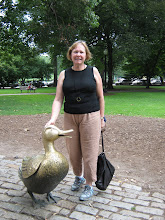
The Library That Made Me celebrates the power of libraries and their enduring place in the hearts of communities across NSW and beyond. For the State Library’s 200th Anniversary, 10 photographers were commissioned to capture images and stories of library users from 65 libraries across regional NSW and metropolitan Sydney. Library users were invited to share personal stories about the libraries that have shaped their lives and identities.
These photographs, now part of the State Library’s collection, offer a contemporary record of libraries today, and celebrate the many ways they connect and inspire us.
This week I met a high school friend who is also a teacher librarian, at the State Library and we looked at the photographs. Many of the Sydney libraries that were included I had visited with two other teacher-librarian friends so it was easy to chat about them and talk about their strengths.
While not all libraries are equal, the photos were certainly a celebration of the positiveness of libraries and all they have to offer. Seeing what people liked most about their libraries made me think of my own life and the role libraries have played in it.
My siblings and school friends were not surprised that I ended up working in a school library sharing books with children. My favourite game to play with them as a child was 'libraries'. This game came about after visiting Bowral Children's Library which was housed in a small building not far from our home. My mother took us there to borrow books, but then when I started school I passed it everyday as I walked to and from school.
I began to pop into the library on my way home to chat to the librarian (I think her name was Miss Shaw) and see what she was doing. My Year 1 teacher had introduced me to A.A. Milne poetry and one day there was a copy of Now We Are Six being discarded. Miss Shaw gave it to me. We didn't have a lot of books at home, other than library books, so I was super excited. It didn't matter that the cover was damaged. My Year 2 teacher read us The Faraway Tree so then I discovered Enid Blyton and started collecting them. Her books were enough to keep me reading for quite some time and as my collection of books grew I set about cataloguing them in the same way that the library did.
Eventually I had quite a few books and they were all 'catalogued' in the same way that the library did. Years later when I was packing up Mum and Dad's house I found a box of my books all with a letter and number written on them. They had been catalogued!
I don't remember either of my primary schools having a library, but my high school in Kiama did. My school friend and I did spend some lunchtimes in the library and it was here that the school teacher librarian introduced us to Women of Courage by Marjorie Darke, a book about the suffragette movement that had a big impact on both of us and also the author, Anya Seton whose books I devoured. Mrs Wilson must have done something right because out of a Year 12 class of about forty students, five of us went on to work as librarians or in libraries.
The next library to influence me was the library at Macquarie University where I did an English and Education degree. I worked weekday mornings from 7.00am till 9.00am shelving books. It was a great way to know where everything was, and dare I say it, to get the books you needed first! This library used the Harvard system, not Dewey so at first it was a steep learning curve, but I came to love the library and the peace it offered early in the mornings.
After teaching for sometime, working as an English consultant, tutoring at university and doing a Masters degree, the opportunity came up to be the teacher librarian for P-2 in the independent school where I was teaching.
Wow my dream job! I have worked in this Preschool to Year 2 Early Childhood Library now for about 30 years. It has been such a pleasure to watch children get excited about books; to take off as readers; to drag their parents into the library to borrow more books; to match children and families to books; to make suggestions of serial stories for teachers; to locate quality mentor texts for classroom topics; and to read my own favourite books to students. This library is such a special space: a mat space for a whole class (a campfire space); table space for a whole class; three waterhole spaces for small groups and some nooks (caves) for individual reading with a plush friend, such as Clifford, or Elephant and Piggie. And around the edges against the walls there is shelving for thousands of books and front-facing displays.
The library is a well-stocked resource for a specific audience. It will be very sad to say good-bye to it when the time comes which may be soon as the K - 6 campus of the school restructures it space.
Four libraries have shaped my life and identity, especially the first and last, which are both libraries that are intended to be especially for children. This tells me that children are never too young to be introduced to books and libraries and that good experiences with books and libraries make readers. In turn, research shows that children who choose to read have better educational outcomes.
On the 30th March, this year the ALIA ACSL Statement on School Library Funding and Resource Provision made clear: investment in school library staffing, collections, programs and facilities is essential to delivering a quality education and supporting student learning and wellbeing, so I do wonder why school executives cannot see the value of libraries beyond them being places to hold meetings and for supervision of classes while their teachers have release time. So many school libraries have so few books given the size of their spaces, so why does our school executive think we have too many books? Can you really have too many books if they are current, in good condition and being used?
I do wonder and more importantly hope that sometime in the future one or many of the students I have taught in this school library are asked by someone to tell them about the library that made them and that their answer echoes my sentiments about the joy of having a specific Preschool to Year 2 library at the school they attended!