Showing posts with label seagrass. Show all posts

Friday, February 28, 2025

1st March World Seagrass Day


World Seagrass Day occurs on March 1st
, becoming Seagrass Awareness Month.  Raising public awareness of the importance of seagrass is crucial to promoting biodiversity and the conversation of seagrass meadows. Unlike seaweeds, seagrass is a grasslike plant that lives in or close to the sea and forms dense meadows. Saving seagrass means saving our seas, as these areas host a myriad of animals species, including supplying 20% of the world's fisheries, sequestrating carbon, supporting communities by providing livelihood, and more. It's estimated that an area large as two football pitches is lost every hour globally.
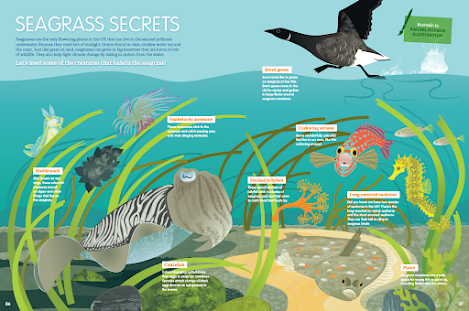


Seagrasses are one of the most widespread marine ecosystems on Earth, covering around 300,000 square kilometres of seabed in 159 countries, including Australia.

Here are 10 facts about this essential plant.  

Observing this day is the result of a decision made by the UN General Assembly (UNGA)  on 23 May 2022. I haven't written about it before or thought much about it till yesterday when I saw that it was coming up and I then began to think about books that I could use to promote this day.


The CSIRO are well ahead of me, as in the last few years they have published some wonderful books, including The Great Southern Reef  by Paul Venzo, Prue Francis and Cate James and The Way of the Weedy Seadragon by Anne Morgan and Lois BuryWhile not only about seagrass, they do include sea ecosystems that children will want to know about. The authors of The Great Southern Reef, were also involved in putting together a comprehensive guide for primary school teachers, called Over and Under the Waves of the Great Southern Reef:Using children's literature to teach marine science in schools. This resource also focuses on  the following picture books:

  1. The Hidden Forest by Jeannie Baker (2005)

  2. The Underwater Forest by Rebecca Morris and Matt Howorth (2020)

  3. The Way of the Weedy Seadragon by Anne Morgan and Lois Bury (2021)

  4. With a Little Kelp from Our Friends by Mathew Bate and Liz Rowland (2021)

  5. Sea Country by Aunty Patsy Cameron and by Lisa Kennedy (2021)

  6. The Great Southern Reef by Paul Venzo, Prue Francis, and Cate James (2022)

  7. Giinagay Gaagal Hello Ocean by Melissa Greenwood (2023)

  8. Secrets of the Saltmarsh by Claire Saxby and Alicia Rogerson (2023) 


    Back to seagrass...the dugongs in Australian waters rely very heavily on the seagrass meadows so look for these books as well

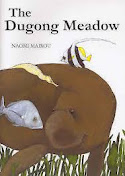
    Dugong Meadow  by Naomi Mairou

    Dugong Dreams  by Deborah Kelly and Lisa Stewart

    Stay Close by Kerrie Uren and Leanne Argent

    Sea-grass Beds  by Kimberley Jane Prior 

    Seagrass Dreams by Kathleen Hanes and Chloe Bonfield

Saturday, May 20, 2023

28th May World Dugong Day

What is a dugong?

Dugongs are large grey mammals which spend their entire lives in the sea. Fully grown, they may be three metres long and weigh 400 kilograms. Dugongs swim by moving their broad whale-like tail in an up and down motion, and by use of their two flippers. They come to the surface to breathe through nostrils near the top of their snouts. Dugongs only hairs are the bristles near the mouth. This short video from National Geographic shows you this.

Dugongs are one of four living species of the order Sirenia, which also includes three species of manatees. Dugongs are related to manatees but their habitats do not overlap.


Where do dugongs live?

Dugongs are found in warm coastal waters from East Africa to Australia, including the Red Sea, Indian Ocean, and Pacific.

Dugongs are largely dependent on seagrass for subsistence so they are found in coastal habitats which support seagrass meadows. The largest dugong concentrations typically occur in wide, shallow, protected areas such as bays, mangrove channels, the waters of large inshore islands and inter-reefal waters. Most of the world's dugong population now occurs in northern Australian waters between Shark Bay in Western Australia and Moreton Bay in Queensland. The Great Barrier Reef region supports globally significant populations of dugong. There is a good map showing the distribution of dugongs in Australia here.

Where did the name dugong come from?

The name was first adopted and popularised by the French naturalist Georges-Louis Leclerc, Comte de Buffon, as "dugon" in Histoire Naturelle (1765), after descriptions of the animal from the island of Leyte in the Philippines. Other common local names include "sea cow", "sea pig" and "sea camel". It is known as the balguja by the Wunambal people of the Mitchell Plateau area in the Kimberley, Western Australia.

Want to know more?

Read:

Dugong Magic  by Deborah Kelly and Lisa Stewart

Wandihnu and the Old Dugong by Elizabeth and Wandihnu Wymarra and Benjamin Hodges

The Dugong Meadow by Naomi Mairou

The Bravest Dugong by Alec Frost and Graeme Compton

Is it a Mermaid? by Candy Gourlay and Francesca Chessa

Facts About the Dugong by Lisa Stratton