Showing posts with label peace. Show all posts

Thursday, October 23, 2025

24th October United Nations Day


The concept of the United Nations is a beautiful one, setting high standards for human, animal and environmental wellbeing so that, one day, we might reach a fairer world. United Nations Day commemorates the anniversary of the UN Charter of 1945.

After World War II, 51 countries united to promote international peace and security, better living standards and human rights. Franklin D. Roosevelt and Winston Churchill are the ones who wrote the declaration, which was then signed by other countries. Antonio Guterres has been the Secretary-General of the United Nations since 2017.

On this UN Day, let’s stand together and fulfil the extraordinary promise of your United Nations. Let’s show the world what is possible when “we the peoples” choose to act as one.

António Guterres
The four main purposes of the United Nations are to:• Maintain International Peace and Security.• Protect Human Rights. • Deliver Humanitarian Aid.• Support Sustainable Development and Climate Action.

This video is a short summary of what this day is all about. School students need to understand how global mindedness and global initiatives can make our world a better place.


There are some general books that outline the role of the United Nations.


If you want to follow up on the 17 United Nation Sustainable Goals please see my book suggestions on Pinterest, one for each of the goals. 


Thursday, December 21, 2023

31st December Universal Hour of Peace


To follow on from my last post and to put more emphasis on the peace angle, here is the perfect book, Peace on Earth by Smitri Halls and David Litchfield. You need to own this book, but you can read it all here.

'Peace on Earth Goodwill to All' is something we all desire, given the conflict raging in the world at the moment and this book is a child-friendly way to have a conversation about conflict and how it might so easily start. A group of friends set off full of joy and anticipation on a journey, but when they become lost, hurtful words cause distress and pain. The friends find strength and inner courage to reconcile their differences and the illustrations show the metaphoric light as the means of restoring harmony.

Given the conflict between Gaza and Israel, many parents have been asking for books that will help explain to their young children why wars happen. The suggestions here from UNICEF in How to talk to your children about conflict and war and from APS in How to Talk to Children About the Hamas-Israel Conflict  are a good place to start.

As UNICEF notes: “It’s important not to minimise or dismiss their concerns. If they ask a question that might seem extreme to you, such as ‘Are we all going to die?’, reassure them that is not going to happen, but also try to find out what they have heard and why they are worried about that happening. If you can understand where the worry is coming from, you are more likely to be able to reassure them.” 

To start discussions with your child or a class choose an age-appropriate book. Some suggestions that I have used:

The Squirrels Who Squabbled  by Rachel Bright and Jim Field

Everybody's Welcome  by Patricia Hegarty and Greg Abbott

Why? by Nikolai Popov

A Child's Garden: A Story of Hope  by Michael Foreman

The Journey  by Francesca Sanna

The Hawk and the Dove  by Paul Kor

The Librarian of Basra  by Jeanette Winter

Noor and Bobby  by Praline Gay-Para and Lauranne Quentric

The Conquerors by David McKee

The Forgiveness Garden by Lauren Thompson and Christy Hale

Go Away, War!  by Elzbieta Gaudasinska (this little book is old but you might find it in a library under this title or Jon-Jon and Annette. It is a translation from French. This moving and hopeful parable about children and war tells how Jon-Jon and Annette play together as best friends until the war comes and they are forbidden to see each other. You can read the book here.)


Every year on December 31st, thirty minutes before midnight, is Universal Hour of Peace . You will have one hour to set an intention around building peaceful relations with others and yourself. The holiday was founded in 1995 by Dr. Barbara Condron from the School of Metaphysics to celebrate peace and call the people of the world to live in peace.


To read with children books that are specifically about peace (maybe not thirty minutes before midnight) see:

Peace by Baptiste Paul and Miranda Paul

What Does Peace Feel Like?  by Vladimir Radunsky

I Am Peace  by Susan Verde and Peter Reynolds

Peace is an Offering by Annette LeBox andStephanie Graegin

Can You Say Peace?  by Karen Katz

Talk Peace  by Sam Williams and Mique Moriuchi

Let There Be Peace and Let it Begin With Me by Jill Jackson, Sy Miller and David Diaz


Wednesday, December 20, 2023

21st December Anne and Samantha Day


Anne and Samantha Day
, celebrated on June 20 and December 21 every year, is a special tribute to celebrate both Anne Frank and Samantha Smith. Anne and Samantha Day takes place twice a year on the summer solstice and the winter solstice. This day is meant to let the world know about the pain, suffering, uproars, and revolution brought by these young women.

Who were Anne and Samantha? What was their contribution to the world?

Anne Frank was a Jewish girl whose writings in her diary — “The Diary of a Young Jewish Girl” — impacted generations. Frank was born in Frankfurt, Germany, on June 12, 1929, to Otto and Ruth Frank. The Frank family fled Nazi Germany and settled in Amsterdam, Netherlands. However, they were still not safe as the Nazis invaded Amsterdam in 1942 and the family needed to go into hiding behind a wall. Here she wrote her diary. Unfortunately the family was betrayed and Anne's father was the only family member who survived. He later found her diary.

Samantha Reed Smith was the daughter of  a social worker, Jane Goshorn Smith. She was born on June 29, 1972. When she was only ten years old, she wrote a letter to Yuri Andropov, who was the leader of the Soviet Union. She wanted to understand the Cold War between the USA and the Soviet Union.

In July 1983 Smith and her family spent two weeks in the Soviet Union, visiting Moscow, Leningrad, and Artek, a children’s camp on the Black Sea. After returning home, she gave numerous television interviews. In a December 1983 speech at the International Children’s Symposium in Kobe, Japan, she suggested that U.S. and Soviet leaders exchange granddaughters for two weeks every year, because a leader would not want to bomb a country that “his granddaughter was visiting.” On August 25, 1985, Smith and her father, Arthur were killed in a commuter plane crash.

These girls were young but very aware of the world they were living in just like so many of the young people today who also are very unhappy about what is happening in the world especially in relationship to the current conflicts and the number of civilian casualties.

Anne Frank and Samantha Smith deserve our recognition as positive influences on schoolchildren. Both of them understood that no matter how difficult the current circumstances are, it is important to strive towards a peaceful future for all nations.

What to do to celebrate this day? Learn more about the two girls, be inspired to do something that involves writing or read about conflict and how it affects children.

You could start with books such as these:

Anne Frank  by Isabel Sanchez Vegara

Behind the Bookcase by Barbara Lowell

The Woman who Rescued Anne's Diary  by Meet Pincus

Anne Frank by Josephine Poole

America's Youngest Ambassador  by Lena Nelson (This is not a book for children but it certainly gives adult readers plenty of food for thought)


Friday, November 18, 2022

21st November World Hello Day


World Hello Day is observed annually on November 21, to express that conflicts should be resolved through communication rather than the use of force. Participants verbally greet ten people or more on that day as an expression of the importance of personal communication in preserving peace. The annual global event began to be celebrated in 1973 as a response to the Yom Kippur War.  

On this day, people are encouraged to participate by simply greeting 10 peopleWinners of the Nobel Peace Prize are among the people who have noted World Hello Day’s value as an instrument for preserving peace and as an occasion that makes it possible for anyone in the world to contribute to the process of creating peace.

So on this day do try to greet at least 10 people. You might also make a point of 'saying hello' to some of the Nobel Peace Prize winners by reading 'their' picture books. Our library has biographies of

Jane Addams (1931)


• The House That Jane Built 


Martin Luther King (1964) 


• Martin Luther King Jnr

Martin's Big Words


Mother Teresa (1979) 


Mother Teresa 

Mother Teresa


Nelson Mandela (1993) 


Nelson Mandela

Long Walk to Freedom 

Nelson Mandela 


Wangari Muta Maathai (2004) 


Planting Peace

Wangari's Trees of Peace

Barack Obama (2009)

At the moment there are not any biographies about Obama in the library, but students know who is and there is one about his wife Michelle Obama.

Malala Yousafzai (2014)

Malala: Activist for Girls' Education


The Right To Learn 


Another way to celebrate this day is one we have done before. Look in your catalogue and collect together all the books that have the word 'hello' in the title. We displayed them for borrowing and asked the students who were browsing the books to say why all these books were there together? The children love guessing what all the books have in common. We had more than twenty books with 'Hello' in the title. Here's some:


Thursday, May 12, 2022

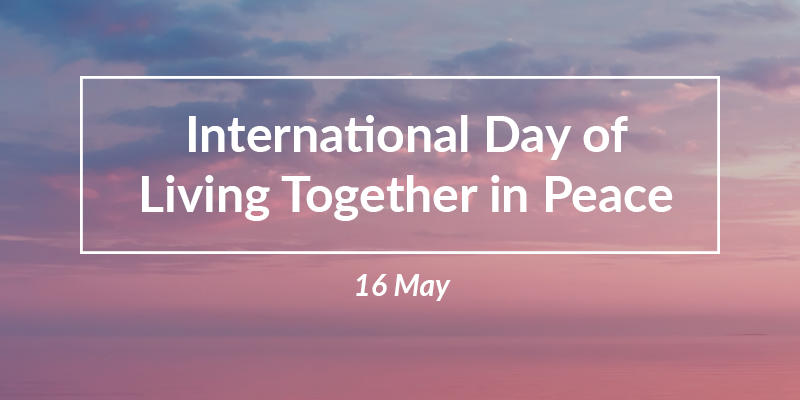
16th May International Day of Living Together in Peace


The International Day of Living Together in Peace is held on 16th May every year. The UN General Assembly, declared 16 May the International Day of Living Together in Peace, as a means of regularly mobilising the efforts of the international community to promote peace, tolerance, inclusion, understanding and solidarity. The day aims to uphold the desire to live and act together, united in differences and diversity, in order to build a sustainable world of peace, solidarity and harmony. 

Living together in peace is all about accepting differences and having the ability to listen to, recognise, respect and appreciate others, as well as living in a peaceful and united way.

Following the devastation of the Second World War, the United Nations was established to save succeeding generations from the scourge of war. One of its purposes is to achieve international cooperation in solving international problems, including by promoting and encouraging respect for human rights and for fundamental freedoms for all without distinction as to race, sex, language or religion.

The declaration came about as a result of the long-held and cherished concept — contained within the Constitution of UNESCO — that "since wars begin in the minds of men, it is in the minds of men that the defenses of peace must be constructed." The Declaration embraces the principle that peace is not merely the absence of conflict, but also requires a positive, dynamic participatory process, in which dialogue is encouraged and conflicts are resolved in a spirit of mutual understanding and cooperation.

Perhaps this year more than ever we need a day like this to focus on what we can do about the plight of Ukrainians. Australia has taken some Ukrainian refugees and so the children we teach may well meet refugee children. When I suggested at school that we did need to ensure that the children we teach had some understanding of what is happening in the world without necessarily scaring them, teachers said the children were too young to know, but I agree with this quote:

‘While children should never have to be in a war, to fail to teach them about the cruelty of warfare and its horrific consequences means that they will be less prepared to make decisions about the wars waged in the future and will be less likely to be empathetic to the innocent victims of war.’

The tricky part of teaching children about war and conflict, of course, is that you want to make sure that the material is not too ‘heavy’ for their age. It is difficult to find age-appropriate books about war for very young children. However, there are several really great books about PEACE that can be used to introduce some of the same concepts and there are picture books which allow young children to empathise with refugees.


If you too are looking, try these:


A simple and colourful book that gets preschoolers and kindergarteners thinking about what peace means in terms they can understand using examples from their daily life, such as, “Peace is sharing a meal.” “Peace is sharing a meal.” “Peace is making new friends.”


A unique book where the author asked children what peace feels like, looks like, sounds like, etc. Answers were gathered from a variety of children and are fun and interesting to read.  


At the beginning, the author ponders what needs to happen in order to bring peace to the world. Through successive pages, filled with poignant quotes from famous peacemakers, the story guides the reader to see how creating peace is a responsibility that we all share.


Like all great picture books, this one is an allegory that can be read on many levels. Superficially, it is about a child who finds a lone plant growing in a war-torn ruin and shows how he nurses it until it covers the barbed wire fence separating him from the other side. For young readers, we can emphasize the message of hope with the vision that one day war ends, and there can be peace. But only if we work at it.


A frog finds a beautiful flower and picks it for himself. When a mouse sees him with it, his jealousy overcomes him, and he swipes it. Frog’s friends come to his aid and chase the mouse away. But before the frogs can celebrate, Mouse’s friends return for a counter-attack. Before long the conflict has devolved into a full-scale frog-mouse war. By the end of it, all either side can ask is: why? This seemingly simple book tackles an important subject and will be an invaluable way to talk to young children about conflict and warfare. 


A young boy discusses the journey he is about to make with his mother. They will leave their town, she explains, and it will be sad but also a little bit exciting. They will have to say goodbye to friends and loved ones, and that will be difficult. They will have to walk and walk and walk, and although they will see many new and interesting things, it will be difficult at times too. A powerful and moving exploration that draws the young reader into each stage of the journey.


A compassionate counting book that captures the power of a welcoming community and teaches children about refugees and how each kindness can help them find a new home. 
More than half of the world's refugees are children fleeing scary situations in search of a safe place to live. 


Hassan feels out of place in a new cold, grey country. At school, he paints a picture showing his colourful Somalian home, covered with the harsh colours of war from which his family has fled. He tells his teacher about their voyage from Mogadishu to Mombasa, then to the refugee camp and on to England. But gradually things change. 


When a young girl has to travel to a new country and start at a new school, her Fear tells her to be alone and afraid. How can she hope to make friends if she doesn't understand their language? 


Saturday, January 15, 2022

SDG 16 Peace, Justice and Strong Institutions.


Goal 16 Promote peaceful and inclusive societies for sustainable development, provide access to justice for all and build effective, accountable and  inclusive institutions at all levels.

The number of people fleeing war, persecution and conflict exceeded 70 million in 2018, the highest level recorded by the UN refugee agency (UNHCR) in almost 70 years. 


Choose a book from here.


Where to start here? Peace, Justice or Institutions? Do students realise there is more to 'peace' than 'silence and no fighting'? Do they know what 'justice' is and when it is needed? Do they realise a school is an 'institution'? Do they understand what makes someone a refugee? All very big questions when you are under eight years old?

Maybe a good place to start with very young children is to look at the rights of a child and there are several picture books that you can use for this. In fact this could be a good place to start all the reading on the Sustainable Development Goals as there is no rule that says you have to start at Goal 1.

Our library has 

I Have the Right to be a Child by Alain Serres and Aurelia Fronty
We Are All Born Free by Amnesty International 
For Every Child  by UNICEF


If you don't have these there is a short film clip that is good called 

I Have the Right to be a Child

https://www.youtube.com/watch?v=tOsq5MVXZzk

I would then read a book about a refugee child who is dealing with a situation which means that some of his/her rights have been denied. Fortunately, now there are so many really good picture books to choose from for this age group. You could use any of these to ask what right is the child being denied and /or how is this child being shown kindness or given hope?

My Name is Not Refuge by Kate Milner

Hello! a Counting Book of Kindnesses by Hollis Kurman and Stephane Barroux

The Colour of Home by Mary Hoffman and Karin Littlewood

A Child's Garden by Michael Foreman

And if you feel that your students are troubled by this, finish on a high note with 

Good People Everwhere by Lynea Gillen and Kristina Swarner.


Here's the blurb:

A colorful picture book that will warm the hearts of children and adults alike, each of its pages contain endearing examples and vibrant illustrations to inspire children to grow into grateful, caring, and giving people. It provides a wonderful way to calm children before sleep, ease their fears, and help them develop an appreciation for good work. Also included are activity pages to help children practice skills for creating gratitude, compassion, and beauty in daily life. 


From the booklet:

Ask • Do you think you are free? What makes you think that?


• We read...


• This story made me think that being free and safe means...