Showing posts with label Michael Foreman. Show all posts

Saturday, July 1, 2023

Read Grow Inspire Book Week Slogan 2023 (Part 6) IMAGERY and SYMBOLISM continued


Now for more of the ways the word 'seed' is used figuratively...


What do we mean when we say 'he sowed a seed of doubt' ? The Seed of Doubt  by Irene Brugnill and Richard Jones illustrates this adage very well. A little boy dreams of a world beyond the farm where he lives – a world full of mountain ranges, oceans and cities, where he could do anything. But one day he plants a seed from which doubts start to grow. Instead of thinking of all that he could do, he thinks more of what he could not. Can he overcome his fears and chase his dreams?


What are 'seeds of compassion'? In the book by His Holiness the Dalai Lama,  The Seed of Compassion he shares stories of his own childhood which highlight this concept. Once an ordinary child named Lhamo Thondup he grew up in a small village in Tibet where his mother taught him about compassion.


What are 'seeds of change'? We hear the saying 'Be the seed. Be the Change' and two books that demonstrate this are  Seeds of Change by Jen Cullerton Johnson and Sonia Lynn Sadler which tells the story of Nigerian Nobel Prize winner Wangari Maathai and next year Nina Laden's new book set in Madagascar, also called Seeds of Change  will look at this metaphor less figuratively as it is not about planting trees, but rather about having the courage and resilience to plant "seeds" that will improve ourselves and our community. It is very poetic


Sow seeds of strength

Ride out the storm.

Sow seeds of compassion 

Make hearts warm.

What about 'seeds of promise'? Teachers hear themselves saying this about a student or situation. In Little Seeds of Promise 
by Dana Raft and Reina Metallinou, Maya feels very lonely and lost when she moves to new country. Her grandmother has given her some seeds to plant when she gets there, but she wonders about whether to plant them and whether she will ever fit in. Can she risk planting them? 

The Seeds of Friendship  by Michael Foreman explores a similar situation through the eyes of a boy called Adam, yet the title likens seeds to friendship rather than promise.


Can a seed be personified? Read A Seed is Sleepy  by Dianna Hutts Aston and Sylvia Long; The Bad Seed by Jory John and Pete Oswald or Seed School  by Joan Holub  and Sakshi Mangal and your students will know that it can be.


You can teach figurative language without having to use the books suggested in the English K-2 units online! Their lists are only suggestions.

Thursday, May 12, 2022

16th May International Day of Living Together in Peace


The International Day of Living Together in Peace is held on 16th May every year. The UN General Assembly, declared 16 May the International Day of Living Together in Peace, as a means of regularly mobilising the efforts of the international community to promote peace, tolerance, inclusion, understanding and solidarity. The day aims to uphold the desire to live and act together, united in differences and diversity, in order to build a sustainable world of peace, solidarity and harmony. 

Living together in peace is all about accepting differences and having the ability to listen to, recognise, respect and appreciate others, as well as living in a peaceful and united way.

Following the devastation of the Second World War, the United Nations was established to save succeeding generations from the scourge of war. One of its purposes is to achieve international cooperation in solving international problems, including by promoting and encouraging respect for human rights and for fundamental freedoms for all without distinction as to race, sex, language or religion.

The declaration came about as a result of the long-held and cherished concept — contained within the Constitution of UNESCO — that "since wars begin in the minds of men, it is in the minds of men that the defenses of peace must be constructed." The Declaration embraces the principle that peace is not merely the absence of conflict, but also requires a positive, dynamic participatory process, in which dialogue is encouraged and conflicts are resolved in a spirit of mutual understanding and cooperation.

Perhaps this year more than ever we need a day like this to focus on what we can do about the plight of Ukrainians. Australia has taken some Ukrainian refugees and so the children we teach may well meet refugee children. When I suggested at school that we did need to ensure that the children we teach had some understanding of what is happening in the world without necessarily scaring them, teachers said the children were too young to know, but I agree with this quote:

‘While children should never have to be in a war, to fail to teach them about the cruelty of warfare and its horrific consequences means that they will be less prepared to make decisions about the wars waged in the future and will be less likely to be empathetic to the innocent victims of war.’

The tricky part of teaching children about war and conflict, of course, is that you want to make sure that the material is not too ‘heavy’ for their age. It is difficult to find age-appropriate books about war for very young children. However, there are several really great books about PEACE that can be used to introduce some of the same concepts and there are picture books which allow young children to empathise with refugees.


If you too are looking, try these:


A simple and colourful book that gets preschoolers and kindergarteners thinking about what peace means in terms they can understand using examples from their daily life, such as, “Peace is sharing a meal.” “Peace is sharing a meal.” “Peace is making new friends.”


A unique book where the author asked children what peace feels like, looks like, sounds like, etc. Answers were gathered from a variety of children and are fun and interesting to read.  


At the beginning, the author ponders what needs to happen in order to bring peace to the world. Through successive pages, filled with poignant quotes from famous peacemakers, the story guides the reader to see how creating peace is a responsibility that we all share.


Like all great picture books, this one is an allegory that can be read on many levels. Superficially, it is about a child who finds a lone plant growing in a war-torn ruin and shows how he nurses it until it covers the barbed wire fence separating him from the other side. For young readers, we can emphasize the message of hope with the vision that one day war ends, and there can be peace. But only if we work at it.


A frog finds a beautiful flower and picks it for himself. When a mouse sees him with it, his jealousy overcomes him, and he swipes it. Frog’s friends come to his aid and chase the mouse away. But before the frogs can celebrate, Mouse’s friends return for a counter-attack. Before long the conflict has devolved into a full-scale frog-mouse war. By the end of it, all either side can ask is: why? This seemingly simple book tackles an important subject and will be an invaluable way to talk to young children about conflict and warfare. 


A young boy discusses the journey he is about to make with his mother. They will leave their town, she explains, and it will be sad but also a little bit exciting. They will have to say goodbye to friends and loved ones, and that will be difficult. They will have to walk and walk and walk, and although they will see many new and interesting things, it will be difficult at times too. A powerful and moving exploration that draws the young reader into each stage of the journey.


A compassionate counting book that captures the power of a welcoming community and teaches children about refugees and how each kindness can help them find a new home. 
More than half of the world's refugees are children fleeing scary situations in search of a safe place to live. 


Hassan feels out of place in a new cold, grey country. At school, he paints a picture showing his colourful Somalian home, covered with the harsh colours of war from which his family has fled. He tells his teacher about their voyage from Mogadishu to Mombasa, then to the refugee camp and on to England. But gradually things change. 


When a young girl has to travel to a new country and start at a new school, her Fear tells her to be alone and afraid. How can she hope to make friends if she doesn't understand their language? 


Saturday, January 15, 2022

SDG 16 Peace, Justice and Strong Institutions.


Goal 16 Promote peaceful and inclusive societies for sustainable development, provide access to justice for all and build effective, accountable and  inclusive institutions at all levels.

The number of people fleeing war, persecution and conflict exceeded 70 million in 2018, the highest level recorded by the UN refugee agency (UNHCR) in almost 70 years. 


Choose a book from here.


Where to start here? Peace, Justice or Institutions? Do students realise there is more to 'peace' than 'silence and no fighting'? Do they know what 'justice' is and when it is needed? Do they realise a school is an 'institution'? Do they understand what makes someone a refugee? All very big questions when you are under eight years old?

Maybe a good place to start with very young children is to look at the rights of a child and there are several picture books that you can use for this. In fact this could be a good place to start all the reading on the Sustainable Development Goals as there is no rule that says you have to start at Goal 1.

Our library has 

I Have the Right to be a Child by Alain Serres and Aurelia Fronty
We Are All Born Free by Amnesty International 
For Every Child  by UNICEF


If you don't have these there is a short film clip that is good called 

I Have the Right to be a Child

https://www.youtube.com/watch?v=tOsq5MVXZzk

I would then read a book about a refugee child who is dealing with a situation which means that some of his/her rights have been denied. Fortunately, now there are so many really good picture books to choose from for this age group. You could use any of these to ask what right is the child being denied and /or how is this child being shown kindness or given hope?

My Name is Not Refuge by Kate Milner

Hello! a Counting Book of Kindnesses by Hollis Kurman and Stephane Barroux

The Colour of Home by Mary Hoffman and Karin Littlewood

A Child's Garden by Michael Foreman

And if you feel that your students are troubled by this, finish on a high note with 

Good People Everwhere by Lynea Gillen and Kristina Swarner.


Here's the blurb:

A colorful picture book that will warm the hearts of children and adults alike, each of its pages contain endearing examples and vibrant illustrations to inspire children to grow into grateful, caring, and giving people. It provides a wonderful way to calm children before sleep, ease their fears, and help them develop an appreciation for good work. Also included are activity pages to help children practice skills for creating gratitude, compassion, and beauty in daily life. 


From the booklet:

Ask • Do you think you are free? What makes you think that?


• We read...


• This story made me think that being free and safe means...


Wednesday, January 12, 2022

SDG 13 Climate Action


Goal 13 Take urgent action to combat climate change and its impacts.


The rising temperature of the Earth is called “global warming.” If the Earth’s temperature keeps getting hotter, we will feel the effects of it. For example, global warming will melt the Arctic’s sea ice and cause the sea level to rise. If the sea level continues to rise, many islands and countries will struggle to stay above water and people and animals will lose their homes. To avoid this from happening, all of us must do something to help the Earth.


Choose a book from here.
A good place to start with young students is to share a book about the shrinking polar icecaps and how the polar bears' habitat is shrinking. They love polar bears (probably because they are majestic and they don't live near them or see them) and there are so many wonderful picture books on this topic. 

However, the students I teach know about the shrinking habitat of polar bears from teachers, parents, documentaries and stunning picture books like Lindsay Moore's Sea Bearso I would start with Hello, Mr World by Michael Foreman. The students understand what it means to be sick so I think this story where Earth has been personified is an excellent way of introducing what is making our world suffer and talking about it.

Here's the blurb:

A topical picture book about the effects of climate change, ideal for very young children.  Michael Foreman brilliantly shows what climate change is doing to our world and inspires us all to make a difference. Mr World doesn't feel well. He's hot and sweaty and finding it hard to breathe. What will the doctors find when they examine their poor patient? 


This could then be followed up by something more didactic or instructive such as A Climate in Chaos by Neal Layton


Old Enough to Save the Planet  by Anna Taylor, Loll Kirby and Adelina Lirius


or Like the Ocean We Rise  by Nicola Edwards and Sarah Wilkins


From the booklet: (Remember these questions and tasks are designed as post reading for the student who is doing this at home with a parent or in class with a teacher and will only read one book from the list, so the responses need to be very open-ended.)

Ask • Have you heard about how there are now less polar bears? Why is this?


• We read...


• This story made me wonder what I could do to...


Monday, December 16, 2019

16th December A Donkey's Christmas

This morning when I checked in at my friend's blog: Momo Celebrating Time to Read, I saw that she has written about the donkey's view of Christmas because of this lovely book The Little Donkey. This reminded me of the year at school where one of the Year 1 teacher's favourite Christmas book was that version of the nativity told from the point of view of the donkey. It started the library staff on a mission to find other donkey books and other nativity stories told in first person from an animal's point of view. We were surprised to find that we had quite a lot of both, so the Christmas display that year ended up being about the animals at the birth of Jesus. It looked wonderful with all the books and soft animal toys out to accompany them. As well as the many donkeys  there were cows, sheep,  a dog, (Room for a Little One),  a cat (Cat in the Manger), a camel (The Last Straw), a hare (Hare's Christmas Gift), and even birds (The Birds of Bethlehem) and spiders (Spider's Gift: A Christmas Story).

Today I had a catch up with the donkey-mad teacher and her two small girls and we talked about Christmas books as she is doing the 25 days till Christmas with her girls, unwrapping a book to read each night. She said that she had tried to buy the donkey book but it was out of print and then she wanted to know the name of a book to buy about the origin of tinsel and we had a chat about Cobweb Christmas  and the other versions of this story. There are just so many wonderful picture books about Christmas and it does seem such a shame that they only really get an airing (reading) at Christmas. Our school year finishes so early in December that for some books that means they're only read once.


Here's what the library has about donkeys that were present at Christmas:
The Little Donkey by Gerda Scheidl and Bernadette Watts
The Lion, the Unicorn and Me by Jeanette Winterson and Rosalind MacCurrach
Ruby the Christmas Donkey by Mirabel Cecil and Christina Gascoigne
Father Christmas and the Donkey by Elizabeth Clark and Jan Ormerod
The Donkey's First Christmas by Susanne T. Schroder
The Ox and the Donkey by Gunter Spang and Loek Koopmans
Little Donkey's Wish by Udo Weigelt and Pirkko Vainio
The Donkey's Dream by Barbara Helen Berger
and some newer ones still available to purchase
Father Christmas and the Donkey by Elizabeth Clark and Ari Jokinen
(the same story as above but with new illustrations instead of Jan Ormerod's)
The Christmas Story as Told by Assellus the Christmas Donkey by Janet Duggan and Catherine Robertson
Mary's Little Donkey by Gunhild Sehlin and Helene Muller

And stories about the spider and the origins of tinsel
Cobweb Christmas by Shirley Climo and Jane Manning
The Christmas Spider's Miracle by Trinka Hakes Noble and Stephen Constanza
The Spider's Gift: A Ukranian Christmas Story by Eric A. Kimmel and Katya Krenina


Tuesday, April 23, 2019

4th May International Respect for Chickens Day

I read about this day online and thought how appropriate as it is a subject I have needed to source books on over the years. The preschoolers and Year 2 at school often have eggs in incubators as part of project based learning or a unit of inquiry that studies life cycles.  see my pinterest page for some of the myriad of books on this topic. Year 1 does a unit on fairy tales and to accompany this in the library we look at chicken and fox stereotypes in narratives.

Chickens are common characters in children's stories and they usually behave in common ways so they are easy to study and make generalisations about. The classic Rosie's Walk is well known to most children and because it is humorous they are very willing to come up with adjectives to describe the hen and the fox. It is the perfect book to start with. Then we look at the traditional story Chicken Licken, (also known as Henny Penny and Chicken Little). You must look at the Emberley's Chicken Little. The illustrations and language will make you smile all day. Which adjectives on our lists apply to the chicken and fox here? Then we compare this chicken with the chicken in The Cock the Mouse and the Little Red Hen. The illustrations and language in this story make the stereotypes very obvious and tap into how fairytales are about good versus evil. These stories also allow for discussion of why sometimes the hen dies and sometimes it doesn't and the same with the fox in the second story. The rich vocabulary allows for discussion of why sometimes the fox lives in a den, sometimes a lair or even a cave. Next I look at the story of Chaunticleer from Chaucer's Canterbury Tales by using Helen Ward's beautiful The Cockerel and the FoxFrom here there are so many other stories where a gullible or enterprising chicken takes on a cunning fox.
See:


Henry and the Fox by Chris Wormell
Hattie and the Fox by Mem Fox
Albert and Lila  by Rafik Schami
A Very Proper Fox by Jan Fearnley
The Chicken Thief by Beatrice Rodriguez

Friday, December 21, 2018

Christmas books for Over 6s

Now for Advent Books to read to the over 6s. I love sharing these because there are so many opportunities to talk about the 'real meaning of Christmas', to consolidate work that classes have done in history units in class, to hark back to discussions in Circle Time and to draw on travel experiences.

1.  Cat in the Manger by Michael Foreman;  The Witness by Robert Westall;  Room For a Little One by Martin Waddell or any other nativity story where the point of view is changed. These three look at the story from the animals point of view. There are many others as well. The donkey's view also often appears in picture books. It is always interesting to be a bystander and report on an event and I enjoy asking students to do this themselves so these stories give them a starting point to form their own view. I read about a picture book this week that gives Joseph's view. How modern!

2.  Refuge by Anne Booth or Flight by Nadia Wheatley. While these two stories appear to tell the story of the journey to Bethlehem they also allow the reader to broaden the concept of Mary and Joseph's journey to encompass the plights of refugees in their journey in search of a safe place.

3. The Legend of the Poinsettia by Tomie DePaola. I have included this as a folktale that explains why poinsettias are part of the Christmas tradition. If you can't find this, look for Cobweb Christmas  by Shirley Climo or  The Spider's Gift by Eric Kimmel  which are folktales explaining why we have tinsel on trees.

4. The Christmas Caravan
 by Jennifer Beck is a lovely story about Simon who wants to enter a competition. This gives you many opportunities to discuss competitions, decorating homes at Christmas and what is required to really appreciate Christmas. It also looks at Southern hemisphere Christmas traditions. Perhaps pair it with The Boxing Day Test by Sharon Willis.

5. Stopping By the Woods on a Snowy Evening by Robert Frost and Susan Jeffers. While strictly speaking it is not a Christmas story it has snow and Susan Jeffers has used touches of red and green with the black and white of night and snow to evoke a very special setting in New England in Winter, when it is Christmas. The vellum cover on the book adds to the mystery and gives it the feeling of a present.

6. Silent Night  by Lara Hawthorne is a new book that brings this beautiful carol by Joseph Mohr to life by featuring the world's diversity as it moves through the lyrics. There are other versions though which highlight the origins of the carol. See Silent Night Holy Night which has beautiful Robert Ingpen illustrations and Silent Night which has Susan Jeffers' illustrations.

7. The Story Holly and Ivy by Rumer Godden. This story can just be read from the novel version, but I love the picture book edition illustrated by Barbara Cooney. I serialise it with my year 1 classes and right from the first sentence, 'This is a story about wishing.' they are hooked.

8. The Christmas Miracle of Jonathan Toomey by Susan Wojciechowski and P.J Lynch is another picture book which draws readers in, allows them to empathise with the characters and be surprised by the ending. The students love the foreshadowing and the lightening of the illustrations as the story progresses and Jonathan's demeanour changes.

9. The Year of the Perfect Christmas Tree by Gloria Houston and Barbara Cooney. I usually read this book to Year 2 in the week of  Remembrance Day in November. This makes the discussion of World War 1 and Ruthie's father's absence very pertinent. This is the nativity play story for older students. They revisit their nativity plays, the standing on chairs and the carol singing.

10. In Flander's Fields by Brian Harrison-Lever  and Norman Jorgenson tells the story of Christmas in the trenches during World War 1 when the fighting stopped, a robin is rescued and the soldiers sing Silent Night in English and German.


11. Fair's Fair  by Leon Garfield. This short chapter book has been published in many formats and with various illustrations. If you can't find the picture book version illustrated by Margaret Chamberlain read it to students without pictures and make them visualise for themselves because hers are so evocative that the rest pale to not be worth sharing.  This story about Jackson, an orphan is set in Victorian times and is told with such suspense that it is a bit scary but the ending is just what student readers require. A good friend found me a new copy of this at the Lifeline Book Fair, so you too could be lucky.

12. A Christmas Carol by Charles Dickens and Quentin Blake. I recommend this to parents of avid readers because when they share it their children make comparisons with Fair's Fair and other books they have read at school and they bring it back saying what great discussions the family had. I grew up with this story as my father had a record of someone reading it that we listened to every Christmas.

Others not to be missed:
Coming Home by Michael Morpurgo; The Polar Express by Chris van Allsburg; Manger by Lee Bennett Hopkins; and Cat on the Hill by Michael Foreman.

Merry Christmas and happy reading.


Sunday, November 5, 2017

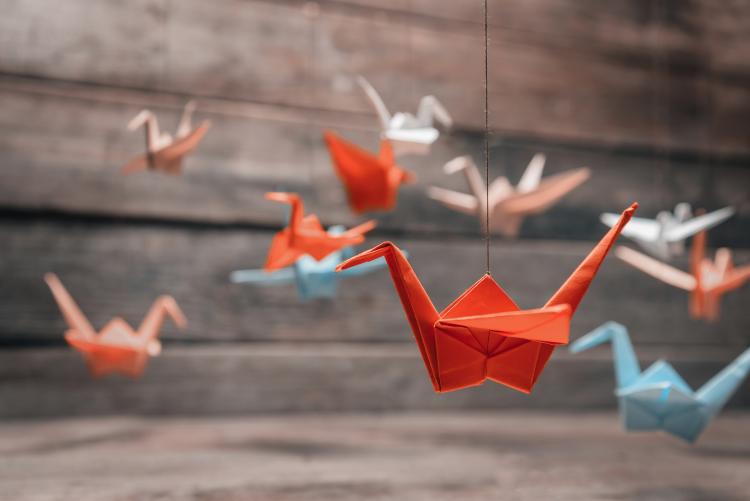
11th November Origami Day

Origami Day was first observed in Japan. It honours the ancient art of creating objects from square pieces of paper.


The origami crane is one of the most recognized origami models around the world.
©bigstockphoto.com/Remains


Amazing objects have been made that are indeed works of art, but at school we will be celebrating by making much simpler animals and having the children who are adept at origami teach their peers. When they have made a recognisable animal there is such a sense of achievement. 

We have a large number of books in the craft section of the library which give students ideas about what is possible, but we also have books where origami is central to the story or poetry in the book. Of course we have Sadako and the Thousand Paper Cranes  in picture book format but there are other picture books as well. See these:
Origami Heart by Binny
Wild Weather  by Thomas Kingsley Troupe (this is one book in a series called Origami Science Adventures)
Fold Me a Poem by Kristine O'Connell George and Lauren Stringer
• The Paper Crane by Molly Bang
Yoko's Paper Cranes by Rosemary Wells 
Little Oh by Laura Krauss Melmed
Tree of Cranes by Allen Say (just perfect for the run-up to Christmas)
• Peace Crane by Sheila Hamanaka
More-igami by Dori Kieber
Butterflies for Kiri by Cathryn Falwell
Float  by Daniel Miyares
The Fog by Kyo Maclear and Kennard Pak
Mole and the Newspaper by Laurence Bourguignon


and
Origami, Poems and Pictures  by The British Museum would make a wonderful present as it comes with the paper and it becomes a family reading, viewing and doing activity.