Showing posts with label Mem Fox. Show all posts

Saturday, August 23, 2025

24th August Ruth Park

It is Ruth Park's birthday. She was born in 1917 and died in 2010. She was the author of  a large number of books for adults and children. Her first children's book was The Muddle-Headed Wombat, but she would go on to write the award-winning children's classics  Callie's Castle; Playing Beat Bow  and When the Wind Changed.

Yesterday I attended the CBCA celebration for its eightieth birthday at the State Library of NSW. Many Australian authors and illustrators who had won Children's Book awards were present. It was so good to be reminded of all the wonderful books from the past and to see just how many of them are still in print, and rightly so. When Margaret Wild spoke she reminded us of her classic book There's a Sea in My Bedroom, which is still in print and regularly borrowed from the school library. In 1985 it made the shortlist for Picture Book of the Year. There was seven books on the shortlist, but none were chosen as the winner. The three commended books were:

MORIMOTO, Junko The Inch Boy 

BAKER, Jeannie Home in the Sky 

COX, David Ayu and the Perfect Moon were commended.

The others on the shortlist were: 

GYNELL, Donna  and Graham, Amanda Arthur 

LACIS, Astra and Mattingley, Christobel The Angel With a Mouth Organ 

WILD, Margaret and TANNER, Jane There’s a Sea in my Bedroom 

FOX, Mem and  VIVAS, Julie Wilfrid Gordon McDonald Partridge 

The last two books are still in print and available to buy new. They have both stood the test of time. Perhaps one of them should have won!


The authors at yesterday's event were called 'legends' and many are still writing, illustrating and being published, but it always interests me when I look back at the winning books to see which ones are still popular. When the Wind Changed  by Ruth Park and illustrated by her daughter, Deborah Niland is one of those books, written long ago, but still in print. Many parents of today's children consider it very dated and inappropriate for young children because it has a gun in it and there is a bank robbery. The adage about what happens to your face when the wind changes is not one that is used these days. However, when you ask the teachers on the staff, 'What was your favourite book as a child?' so often some teacher (usually male) will say this book. One year we had a match the teacher to the book contest and I put the books out on display. Yes you guessed it, When the Wind Changed  was the book that was borrowed the most.


Each of these three books have had a fortieth anniversary edition. Will this year's winners still be in print in 40 years. I wonder.


Wednesday, July 17, 2024

21st July Lamington Day


lamington is an Australian cake made from squares of butter cake or sponge cake  coated in an outer layer of chocolate or chocolate icing and rolled in desiccated coconut. 

21st July was designated as National Lamington Day in Australia to commemorate an Australian stalwart cake. The history of it is fascinating if you believe what Wikipedia says.

The earliest known reference to the naming of the lamington, from June 1927, links the cake to Lord Lamington, who served as Governor of Queensland from 1896 to 1901. Most stories attribute its creation to Lord Lamington's chef, the French-born Armand Galland, who was called upon at short notice to feed unexpected guests. Using only the limited ingredients available, Galland cut up some left-over French vanilla sponge cake baked the day before, dipped the slices in chocolate and set them in coconut. Coconut was not widely used in European cooking at that time, but was known to Galland, whose wife was from Tahiti, where coconut was a common ingredient.

It is timely that there is this day to celebrate lamingtons because next month it will be Australian Children's Book Week where the slogan is Reading is Magic. In Australia's most well known picture book Possum Magic the magic 'device' is a lamington. A bite of lamington will make Hush visible again. What a good excuse to reread an old favourite!

There is a copy of mom Fox's lamington recipe here.

Surprisingly, there's not a lot of other story books which feature lamingtons. Your library might have a copy of The Lamington Man by Kel Richards which is a Gingerbread Man story with a lamington instead.

Tuesday, April 23, 2019

4th May International Respect for Chickens Day

I read about this day online and thought how appropriate as it is a subject I have needed to source books on over the years. The preschoolers and Year 2 at school often have eggs in incubators as part of project based learning or a unit of inquiry that studies life cycles.  see my pinterest page for some of the myriad of books on this topic. Year 1 does a unit on fairy tales and to accompany this in the library we look at chicken and fox stereotypes in narratives.

Chickens are common characters in children's stories and they usually behave in common ways so they are easy to study and make generalisations about. The classic Rosie's Walk is well known to most children and because it is humorous they are very willing to come up with adjectives to describe the hen and the fox. It is the perfect book to start with. Then we look at the traditional story Chicken Licken, (also known as Henny Penny and Chicken Little). You must look at the Emberley's Chicken Little. The illustrations and language will make you smile all day. Which adjectives on our lists apply to the chicken and fox here? Then we compare this chicken with the chicken in The Cock the Mouse and the Little Red Hen. The illustrations and language in this story make the stereotypes very obvious and tap into how fairytales are about good versus evil. These stories also allow for discussion of why sometimes the hen dies and sometimes it doesn't and the same with the fox in the second story. The rich vocabulary allows for discussion of why sometimes the fox lives in a den, sometimes a lair or even a cave. Next I look at the story of Chaunticleer from Chaucer's Canterbury Tales by using Helen Ward's beautiful The Cockerel and the FoxFrom here there are so many other stories where a gullible or enterprising chicken takes on a cunning fox.
See:


Henry and the Fox by Chris Wormell
Hattie and the Fox by Mem Fox
Albert and Lila  by Rafik Schami
A Very Proper Fox by Jan Fearnley
The Chicken Thief by Beatrice Rodriguez

Tuesday, June 6, 2017

14th June International Bath Day

It is International Bath Day. So many children's books feature bathing, either as the story, a good way to finish a story or 'for shock value' with very young children, so on this day for celebrating baths I have put together a fun display in the library. I know most of the books will leave the library.
Remember even Harry the Dirty Dog and Paddington Bear have baths!

Probably the most well known bath story would be Pamela Allen's Mr Archimede's Bath. This book is still in demand both with children and teachers who are using it for a science lesson. Time to Get Out of the Bath, Shirley  by John Burningham is perfect for a visual literacy lesson as it tells two conflicting stories through the pictures and words. My preschoolers love Emma Quay's Rudie Nudie 'because they have no clothes on!'. One of my Year 2 teachers serialises Harry the Poisonous Centipede by Lynne Reid Banks and the children giggle at the thought of a centipede coming up the drain in the bath. The picture books about bath monsters, sharks and giraffes in the bath and  have a similar effect on younger reader.

When my son was young he was mad on fishing and we had a Keith Faulkner book, A Fisherman's Tale about a boy who caught a fish that he kept in the bathtub because it kept growing until it was obviously a whale. I think it was his ultimate fantasy. Maybe There's a Dinosaur in the Bathtub will do that for a young reader today. Whale in the Bath by Kylie Westaway would be one of the most borrowed picture books this year so far. I'm sure the Premier's Reading Challenge sticker helps but given the number of books in the library with stickers it must have something else going for it. And if it is a while since you've read Glenda Millard's Unplugged!  dig it out and at least you'll feel warm.


SaveSave

Sunday, August 28, 2016

22nd - 26th August Book Week

Well another Book Week in Australia is over. This year's theme Australia: Story Country proved to be a good one and each class at my school celebrated with an Australian book that they read and  used as inspiration for discussions and response activities that highlighted places in Australia, either in the form of travel to places mentioned or to the home of authors, illustrators or famous Australians.
Each class did a one page 'postcard' to display for the whole school population and visitors to read read in the corridor. It was a huge success. On Grandparents Day on Friday the corridor was full of children showing adults their work and discussing the books displayed along side. See images below that when joined together made a long Rainbow Serpent winding its way to the library. Not all classes work is here as some had photos or identified specific children. The teachers chose the books to either fit with a unit of enquiry, because it was a favourite book or author or because the students showed interest in it. I was so impressed with the range and what each class did.

There are four classes per grade. The books chosen were:

Kindergarten
* My Place  by Nadia Wheatley and Donna Rawlins
* Silly Birds  by Gregg Dreise
* Snugglepot and Cuddlepie (new paperback single story editions) by May Gibbs and Mark McLeod
* Koala Lou  by Mem Fox and Pamela Lofts
Year 1
* Are We There Yet? by Alison Lester
* Bright Star  by Gary Crew and Anne Spudvilas
* Where the Forest Meets the Sea  by Jeannie Baker
* Tiny: A Little Dog on a Big Adventure  by Jennifer Castles and Steve Otton
Year 2
* Enora and the Black Crane  by Arone Raymond Meeks
* Feathers and Fools by Mem Fox and Nicholas Wilson (US) and Lorraine Ellis (Aus)
* Home  by Narelle Oliver
* You and Me Murrawee by Kerri Hashmi and Felicity Marshall


Thursday, July 21, 2016

21st July National Lamington Day

The 21st July is  in Australia. We started term 3 on Monday with lamingtons for morning tea on our PD day. They were yummy and we all said what a good way to start the term. I also thought to myself, what a good way to start a term in the library where the theme Australia: Story Country was going to be at the forefront. The children know the story of Possum Magic so well that they are quick to tell you that Hush eats a  lamington to make himself visible again.
Lamington Day

In Hobart, late one night, in the kitchens of the casino, they saw a lamington on a plate. Hush closed her eyes and nibbled. Grandma Poss held her breath - and waited.
"It's worked! It's worked!" she cried. And she was right. Hush could be seen from head to tail. Grandma Poss hugged Hush, and they both danced "Here We Go Round the Lamington Plate" till early in the morning. 
So from that time onwards, Hush was visible. But once a year, on her birthday, she and Grandma Poss ate a Vegemite sandwich, a piece of pavlova and half a lamington, just to make sure that Hush stayed visible forever.
And she did.
Possum Magic, Mem Fo

 Just bought the 2015 edition of The Possum Magic Cookbook and it has a lamington recipe along with other Australian classics.


The Lamington Man  by Kel Richards is an Australian Gingerbread man story and while it is lightweight it would be fun to share with the story of Lord Lamington and how lamingtons came to be.

Yesterday with my Kindergarten classes we talked about things that were 'Australian', authors that were 'Australian' and places in Australia. We talked about where they went in Australia during the holidays and we located them on a large map of Australia that I have affixed to the floor in the library.  This proved to be a big success. The sign around the kangaroo's neck says 'Hop in and read!' The Kindergarten students did lots of hopping on the map as you can imagine.

Sunday, January 10, 2016

14th January Shoe Buying Day

The PBS Calendar lists activities for parents to share with their children each day and today they are buying shoes. In Australia it is an activity that is on many parent-to-do lists as the new school year starts in two weeks. Remember that scene when Alexander is made to buy 'plain old white ones' when shopping for sneakers with his mother and brothers in Alexander's Terrible Horrible No-Good Very Bad Day.

I went searching for a Shoe Day as after all there does seem to be a day for everything else even 'socks', but besides Two Different Coloured Shoes Day on 3rd May and Sneakers Day on 9th October there wasn't a specific Shoe Day. So I'm instigating one, by saying there is a multitude of books, rhymes and songs which to explore when celebrating 'shoes'. And I have decided to start the term with my preschool classes doing that. I will have four or five lessons with each group so I think we will probably look at some aspect of shoes for each session. Usually we have a book, a rhyme or song and some activity.

They will all have new shoes and we will have plenty to look at, compare and discuss. We will see who has shoelaces, who has buckles and who has velcro. We will start with the book Whose Shoes? and find out how many different shoes there are and how many words we have for types of shoes. This video and song will help add to the list of shoes too.

We will have fun with Pete the Cat. He has two books which feature shoes... Pete the Cat: Rocking in my School Shoes and Pete the Cat: I Love My White Shoes The children love to sing along with these which we can do courtesy of YouTube.

In each lesson with preschoolers I also like to introduce or revisit a nursery rhyme as they enjoy reciting them and don't know them like they used to. There are four that I can think of that feature shoes.
• 1 2 Buckle My Shoe
• There Was an Old Lady
• Cobbler Cobbler
• Diddle Diddle Dumpling My Son John

There are also a large number of songs complete with actions here.

While 'rhyme' is centre-most with preschoolers it will be fun to share books that are written in rhyme like
What Can You Do With a Shoe?  by Beatrice Schenk de Regniers and Maurice Sendak. What a great question to discuss before even reading the book. Then look at the rhyme...
What can you do with a shoe? You can put it on your ear or wear it on your head or butter it like bread or use apple jam instead!
• Grandpa's Slippers by Joy Watson. This is part of a series of books about Grandpa and his clothing. They are written in rhyme and children and grandparents both laugh when these are read aloud.
Shoes From Grandpa by Mem Fox and Patricia Mullins. This is a cumulative rhyme where family members describe the clothes they plan to give Jessie to go with the shoes from Grandpa.


Next dogs and shoes. Discuss what dogs do with shoes and then introduce these three books:
One Two That's My Shoe! by Alison Murray
Shoe Dog by Megan McDonald and Katherine Tillotson
A Dog Wearing Shoes  by Sangmi Ko.
Each of these is humorous and likely to enthuse the children to talk.

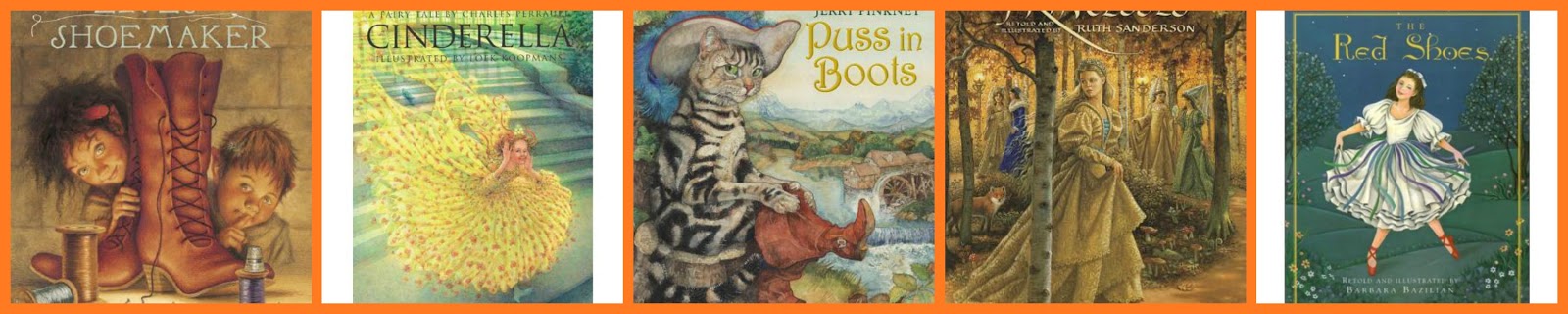
And of course there's always fairytales. Here are five which feature shoes:
Cinderella
• The Elves and the Shoemaker
• Puss in Boots
• The Twelve Dancing Princesses , and
• Red Shoes  by Hans Christian Andersen.

See the shoe possibilities really are endless!

Sunday, August 17, 2014

18th August Book Week Connecting to Reading Part 1

It is Children's Book Week in Australia and the theme 'Connect to Reading' has meant some very insightful reading has been happening in my library. My 5  to 8 year olds have been reading from the Early Childhood and the Picture Book shortlists. We have been connecting these titles to other older books that they may not have known too.

We haven't done any art or craft activities yet. I am saving the Reading to Connect activities for fun in the library this week when we will draw with rainbow pencils and paint with mud, as Ann James does in I'm a Dirty Dinosaur, try to draw a duck in a minute inspired by Silver Buttons and make plastic bag parachutes to float our teddies off the second floor down onto the playground.

So far though we have made text-to-text connections between the two lullabies on the Early Childhood shortlist Baby Bedtime and Kissed by the Moon. We played lullaby music and lay down on the mat as I read.

We read The Swap and connected it to Pat Hutchins 1985 classic The Very Worst Monster which is also about sibling rivalry and the need to get rid of a sibling.

We read Banjo and Ruby Red  and connected it with many books Year1 and I had read last term when we looking at chickens and foxes in picture books and talking about stereotypes. The children thought it reminded them of Albert and Lila,  a chicken and pig story where they help each other to outwit a fox and The Chicken Thief  because 'the hen and fox become good friends'. This connection also led to us reconnecting with Bear and Chook the good friends in Lisa Shanahan's award-winning books.

And although we live near the beach, the concept of grommet was very new to my students, so to read Granny Grommet and Me  we first looked at some surfing books and the news report about granny grommets. One of my students connected this story with Olivia Learns to Surf because in it Olivia is taught to surf by her grandmother. We quickly visited it, but the children were much more interested in talking about sea dragons so that is where we went, off exploring them. The book Seahorses and Seadragons led us to connections of all kinds especially once the students discovered from the maps that they could be found in the sea off Sydney. Next we read another Australian picture book Seadragon Sea  by Margaret Spurling.

The shortlisted Early Childhood books were well received by Kindergarten and Year 1 students, but The Swap  and Banjo and Ruby Red  were the most popular by far when we pretended to be judges and voted, so for once the judges agreed with the children which often isn't the case. It is a fitting tribute to Jan Ormerod to have her last book achieve such an award!

Saturday, September 21, 2013

21st September World Alzheimer's Day

September is World Alzheimer's Month and today, 21st September is World Alzheimer's Day, a day when we need to raise awareness about Alzheimer's, the most common form of dementia, and the need for more education, support and research. While there are now a few books that overtly explain this disease to young children, some of the more subtle picture books which depict older people and memories give teachers the ideal way in to discuss ageing, dementia and what their students know about it and have experienced first-hand. Five books that come to mind are
Wilfrid Gordon McDonald Partridge by Mem Fox and Julie Vivas
Remember Me  by Margaret Wild and Dee Huxley
Mile -High Apple Pie  by Laura Langston and Lindsey Gardiner
Still My Grandma by Veroni Van den Abeele and Claude K. Dubois
The Memory Box by Mary Bahr and David Cunningham
The Memory Box is particularly good and I was pleased to see that someone agrees with me here.


Saturday, November 17, 2012

17th November World Peace Day

I struggle to see exactly what the difference is between this day and International Day of Peace which is held on 21st September, but I guess it really doesn't matter how many Peace Days there are, it is something we should be thinking about on a daily basis. World Peace Day requests that each person take a moment to fold a couple of paper cranes and mail them to a world leader or hang them in a place that is visible to the public. One of the Kindergarten classes at school did this just this week. One of the students had learned to make origami cranes and she taught her peers to do it. The teacher took the opportunity to send to the library for the picture book version of Sadako by Eleanorr Coerr and Ed Young She read it to the class and of course it is a lot for six year olds to take on board, but there were plenty of questions and because of the paper folding they will remember the story.

When I read the poemPeaceguy's Prayer by Don Morris that is posted on websites about World Peace Day I can't help but think about how powerful these lines from the beginning of the poem are.

May the people on this planet be changed
Changed from hatred to love,
Changed from greed to giving,
Changed from selfishness to selflessness,
Changed from apathy to action,
Changed from jealousy to joy over someone's accomplishments,
Changed from intolerance to acceptance,
Changed from being destructive to being constructive,
Changed from fighting to peace,
Changed from killing to protecting life,
Changed form censorship to freedom,
Changed from ignorance to education,
Changed from fearing our differences to rejoicing our variety.


Of course there are many picture books that you could choose to illustrate the ideas presented here, but immediately I thought of these. They may not be easy to buy, but search them out in the library because you will not be disappointed. Lessons planned with these and class discussions on these are always rewarding.

* Feathers and Fools  by Mem Fox. This wonderful book about a fight among birds allows children to step back initially because the protagonists are not people, but they are quick to draw parallels after the story is finished. (Please note if you are in Australia this book may have a different illustrator. It has a blue cover.)

* Milo and the Mysterious Island by Marcus Pfister. This story is the sequel to Milo and the Magical Stones, but this time the cliff mice sail off on a raft  to explore a tropical island. Here they meet a tribe of striped mice. Like its predecessor this book also has two endings offering two resolutions to the  conflict between the mice.


Tuesday, March 2, 2010

5th March Errol Le Cain (1941 - 1989) Mem Fox (1946) Jack Bedson (1950)


Three birthdays! Errol Le Cain I have mentioned before for his fairytale illustrations. They are very special. Unfortunately his books are very hard to find now. You can't buy them new and library copies are often in very poor condition. Such a shame. They need reprinting as they bring a wonderful richness to fairytales that no Disney or Brimax edition will ever be able to do. I'd love to have a copy of Molly Whuppie for use during Book Week. It has a 'bridge' in it! To learn more about Le Cain and see his exquisite artwork see Tania Covo's very informative website about him www.errollecain.com .

Jack Bedson is hardly famous, but two of his books, Don't Get Burnt! and Sheep Dogs are iconic Australian picture books and well worth a look. They too are probably out of print.

Mem Fox's books aren't out of print. They are so popular. A Year 2 girl who is a very good reader and who can read nearly anything in the library said to me just this week, "Green Sheep is still my favourite book. I've loved it since I was three! And now I read it to my little brother."

Another favourite with especially Year 2 is Wilfrid Gordon McDonald Partridge. They do a unit of enquiry where they look at the past and where they interview their parents and grandparents and write their autobiography. This book elicits discussion about memories in a very warm way. My favourite book is Hattie and the Fox. It is so easy to read exuberantly! Not as exuberantly though as Mem reads herself. She is the epitome of reading aloud and storytelling.

Other wonderful things about Mem, besides her books are her storytelling and what she has to say to teachers and parents. Whenever I want to be reminded about why I believe a particular thing or if I am struggling to convince parents as to why something is a good idea I visit Mem's website and reread her articles. I especially like the one on the Folly of Phonics which she gave to principals in NZ because it reminds me about why I believe so strongly in children's literature and tradebooks rather than reading schemes and isolated skills.